Best Dog Foods With Probiotics for a Goldendoodle's Gut Health
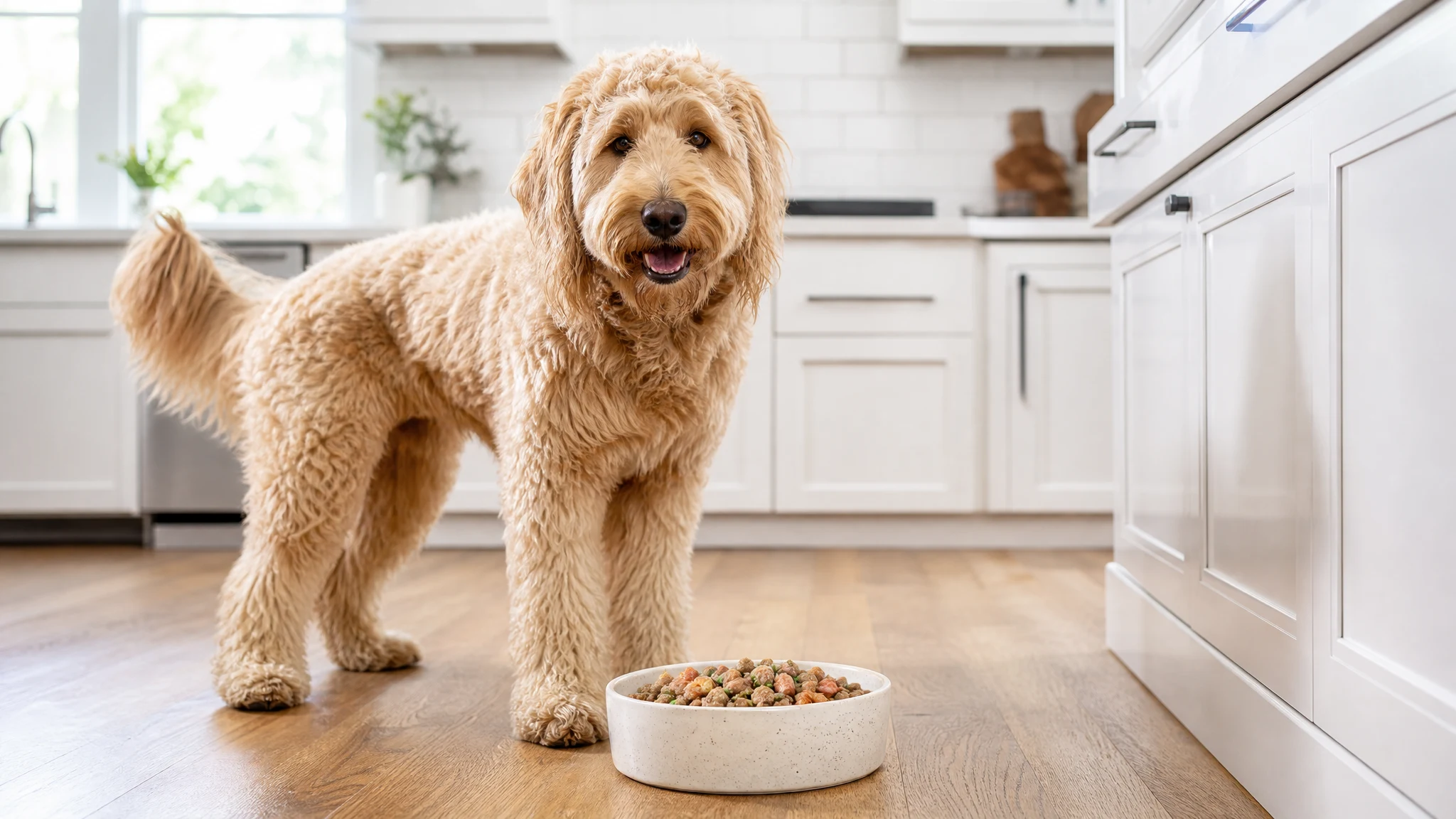
General nutrition information compiled from product labels and published sources, not veterinary advice. Your veterinarian is the right person to choose a diet for your dog, especially one with a health condition.
Many Goldendoodle owners start thinking about dog probiotics for gut health after a bout of loose stools, a food switch that went badly, or a bag that advertises "digestive support." The label deserves a careful read before you trust any of that.
This guide covers what a food label can and cannot tell you about probiotics. It also shows how several well-known foods compare on label data, and it lists the red flags worth knowing. It makes no medical claims. A veterinarian decides what is right for an individual dog.
How we compared these foods
We compared label data only: the AAFCO statement, life stage, first ingredients, protein, fat and calories published on each brand's own page. We did not run feeding trials or taste tests, and we did not feed any of these foods to dogs. Nothing here is a rating of how a food performs in a real dog.
One more point matters for this topic. The product pages we reviewed do not give probiotic strains or counts in the data we compared. We therefore do not say that any food below contains live probiotics. Check the brand's own label or ask the company directly. If probiotics matter to you, that step cannot be skipped.
For a wider comparison that is not limited to probiotics, see our label-by-label Goldendoodle dog food comparison.
Start with the Goldendoodle, not the probiotic
A Goldendoodle is a Golden Retriever and Poodle cross. There is no kennel-club standard for it. The Goldendoodle Association of North America (GANA), a breeder association, sorts the dogs by height. Its typical weights run from 25 lb or less for a petite mini to 51 lb or more for a standard. Size depends on the Poodle parent and the generation, so your dog's adult weight may fall anywhere in that range.
That size range changes which food makes sense. A petite mini and a standard Goldendoodle puppy have different needs. Pick the right size and life stage first. A probiotic claim on the wrong formula is not a good trade.
Health predispositions come from the parent breeds, and no source we found documents them for Goldendoodles as such. A Goldendoodle can inherit tendencies from either side. For example, the Merck Veterinary Manual notes that Poodles are among breeds with a reported increased prevalence of pancreatitis. It also reports hepatoportal microvascular dysplasia in Toy and Miniature Poodles. These are reasons to talk to your veterinarian before changing diets, not reasons to reach for a supplement on your own.
What to look for: quality indicators
1. A complete and balanced AAFCO statement
This is the first thing to find. The statement says either that the food was formulated to meet AAFCO nutrient profiles or that animal feeding tests substantiate it. It also names the life stage. A food with a lovely probiotic story but no clear statement is not a food to build a diet around.
2. The right life stage and size wording
The Merck Veterinary Manual explains that a food labelled for growth or all life stages must say either "including growth of large-size dogs (70 lb or more as an adult)" or "except for growth of large-size dogs." The "including" wording means the food meets the calcium levels AAFCO sets for large-size growing dogs. That matters for standard Goldendoodle puppies, because the Merck Manual notes that excess calcium is more of a problem for growing large-breed dogs. Mini and petite sizes are small dogs, so they have different needs.
3. A named protein as the first ingredient
Look at the first five ingredients. A named animal protein such as chicken or turkey is easy to understand. A "by-product meal" is not automatically bad, but it tells you less about the source, and it is worth noticing.
4. A clear probiotic statement, if you want one
Some labels list fermentation products or named microorganisms. If you are shopping for dog probiotics for gut health, look for the organism names in the ingredient list or a statement on the brand's page. A vague line such as "digestive blend" does not tell you what is in the bag. We could not confirm probiotic content for the foods below from the data we reviewed, so ask the brand.
5. Calorie information you can use
Calories per cup let you judge portions. The AKC notes that some Golden Retrievers can become overweight, and a Goldendoodle can inherit that tendency. Treat the label feeding guide as a starting point. Adjust with your veterinarian based on your dog's body condition.
Key features to compare
- Life stage: puppy, adult, senior or all life stages.
- Size focus: small and mini, medium, or large breed.
- Form: dry, wet or fresh. Each handles storage and feeding differently.
- Protein, fat and calories: compare on the same basis. Some brands publish guaranteed analysis, and others publish dry-matter averages.
- Probiotic details: named organisms, or an honest "not stated."
- Feeding guide: a starting point, never a final answer.
Label data side by side
The table uses only what each brand publishes on its own product page. "Not published" means the brand page did not give that figure in a form we could compare. Hill's pages show dry-matter averages instead of a guaranteed analysis, so those figures are marked "DM" and cannot be compared directly with the others.
| Food | Form | Life stage | First ingredients | Protein / fat | Calories |
|---|---|---|---|---|---|
| Royal Canin Large Puppy | Dry | Large breed puppy, up to 15 months | Chicken by-product meal, corn, wheat, chicken fat, wheat gluten | 28% min / 14% min | 349 kcal ME per cup |
| Hill's Science Diet Puppy Large Breed | Dry | Large breed puppy, up to 18 months | Chicken, brown rice, whole grain oats, chicken meal, cracked pearled barley | 26.3% / 15.4% (DM) | 391 kcal per cup |
| Hill's Science Diet Puppy Small & Mini | Dry | Puppies up to 1 year | Chicken, whole grain oats, brown rice, chicken meal, chicken fat | 28.9% / 19.7% (DM) | 418 kcal per cup |
| Royal Canin Medium Adult | Dry | Adult medium breed, over 12 months | Brewers rice, chicken by-product meal, oat groats, wheat, corn protein meal | 23% min / 12% min | 340 kcal ME per cup |
| Royal Canin Large Adult | Dry | Adult large breed, over 15 months | Chicken by-product meal, brewers rice, wheat, brown rice, chicken fat | 24% min / 15% min | 360 kcal ME per cup |
| Hill's Science Diet Adult Large Breed | Dry | Adult, 1 to 5 years | Chicken, cracked pearled barley, brown rice, brewers rice, whole grain wheat | 23.8% / 15% (DM) | 365 kcal per cup |
| JustFoodForDogs Chicken & Rice | Fresh, frozen | All life stages, including large-size growth | Chicken, long-grain white rice, long-grain brown rice, carrots, kale | 8% min / 3% min | 43 kcal ME per oz |
| Nom Nom Turkey Fare | Fresh | All life stages, including large-size growth | Ground turkey, brown rice, egg, carrots, spinach | 9% min / 4% min | 244 kcal per cup |
Fresh foods hold far more water, so their protein and fat percentages look lower than dry food. That does not mean they are lower in protein once water is taken out. Compare like with like, or ask the brand for dry-matter figures.
Top picks by dog size and food type
We cannot give prices. They change by retailer, bag size and location, and the brand pages we reviewed did not give a price we could cite. Instead, the picks below are grouped by food type and Goldendoodle size. Check each brand's own page for current pricing and for any probiotic statement.
Dry foods for everyday feeding
Standard Goldendoodle puppies. Royal Canin Large Puppy carries the "including growth of large size dogs (70 lb. or more as an adult)" wording. Hill's Science Diet Puppy Large Breed is substantiated by AAFCO feeding tests, but its page statement does not carry that "including" phrase. Do not read more into it than the label says. Ask your veterinarian which fits your puppy.
Mini and petite puppies. Hill's Science Diet Puppy Small & Mini is labelled for puppies up to 1 year old. Its calories per cup are higher than those of the large-breed puppy foods in the table, so measure carefully.
Adult dogs. Royal Canin lists a Medium Adult formula for dogs 23 to 55 lb and a Large Adult formula for dogs 56 to 100 lb. Hill's lists an Adult Large Breed formula for dogs with an ideal weight of 55 to 110 lb. Pick the one that matches your dog's expected adult weight, not just the bag that sounds closest.
Fresh foods
JustFoodForDogs Chicken & Rice and Nom Nom Turkey Fare both state that they meet AAFCO profiles for all life stages, including growth of large size dogs. Both are stored frozen or cold and used within about 5 days of thawing. Nom Nom portions each meal for the individual dog from the information the owner provides. Fresh foods usually cost more per day than dry food. Check the brand pages for current pricing before you commit.
Wet food
Hill's Science Diet Adult Chicken & Barley Entree is the one wet option we reviewed. It is for adult dogs 1 to 6 years old and comes in a 13 oz can. A can works well as a topper, but follow the feeding table and count the calories.
Red flags to avoid
- Disease claims. A food or supplement that says it prevents, treats or cures hip dysplasia, allergies, DCM, bloat or any other disease is making a promise a label should not make. Only a veterinarian can prescribe a therapeutic diet.
- No AAFCO statement. Without it you cannot tell whether the food is complete and balanced.
- Wrong life-stage wording. A food labelled "except for growth of large-size dogs" is a poor match for a standard Goldendoodle puppy.
- Probiotic wording with no detail. "Contains probiotics" with no organism names or counts is hard to evaluate.
- Promises. Phrases such as "results you can count on" or "100% digestive health" are marketing, not nutrition.
- Treating grain-free as a safety feature. The FDA began investigating reports of DCM in dogs eating certain foods in July 2018. Many were labelled grain-free and had peas, lentils, other pulses or potatoes among the first 10 ingredients. The FDA's latest public update is dated December 23, 2022, and it has said it will not post more until there is meaningful new science. UC Davis researchers also found taurine-deficient DCM in golden retrievers, most of them on grain-free or legume-rich diets. None of this shows that grain-free food causes DCM, and it is a good reason to talk to your veterinarian before choosing such a diet for a dog with Golden Retriever parentage.
- Supplement dose advice from a bag or website. Dosing is for your veterinarian to set.
When the gut is the problem, call your veterinarian
A food with probiotics is not a treatment. If your Goldendoodle has diarrhea that lasts more than a day or two, vomiting, blood in the stool, lethargy or weight loss, see a veterinarian before changing the diet. Puppies and small dogs can go downhill quickly. Standard Poodle parentage also carries a higher risk of bloat, according to the AKC. That is an emergency, and no food or probiotic is the answer to it.
If you switch foods, do it gradually and follow the brand's guidance. Keep the change to one new thing at a time so you can tell what changed.
Where to buy
The safest approach is to start at the brand's own product page. Royal Canin, Hill's, JustFoodForDogs and Nom Nom each publish the AAFCO statement, ingredients and calories there, and that is where to look for any probiotic details. The brand pages also tell you which stores or delivery options they use.
Whatever you buy, keep the bag or take a photo of the label. Check the life-stage wording and the date on the package. Your veterinarian's office can also tell you which foods they are comfortable recommending for your dog's size and age.
For fresh foods, confirm the freezer space and the thaw-and-use window before ordering. Both fresh brands we reviewed use food within about 5 days of thawing.
A short checklist before you buy
- Match the food to your Goldendoodle's expected adult size and current life stage.
- Find the AAFCO statement and read the exact wording.
- For a standard puppy, look for "including growth of large-size dogs."
- Read the first five ingredients.
- Ask the brand what probiotics are in the food, if any, and in what form.
- Check calories per cup and use the feeding guide as a starting point.
- Talk to your veterinarian about your dog's individual needs.
For more foods compared on the same basis, read our label-by-label comparison.
Sources
- Goldendoodle Association of North America, Goldendoodle Breed Standard
- American Kennel Club, Golden Retriever breed page
- American Kennel Club, Poodle (Standard) breed page
- Merck Veterinary Manual, Dog and Cat Foods
- Merck Veterinary Manual, Nutritional Requirements of Small Animals
- Merck Veterinary Manual, Pancreatitis in Dogs and Cats
- Merck Veterinary Manual, Congenital and Inherited Anomalies of the Liver in Animals
- U.S. FDA, Investigation into Potential Link between Certain Diets and Canine Dilated Cardiomyopathy
- UC Davis, Dogs Fed Some Popular Diets Could Be at Risk of Heart Disease
- Royal Canin US, Large Puppy Dry Dog Food
- Royal Canin US, Medium Adult Dry Dog Food
- Royal Canin US, Large Adult Dry Dog Food
- Hill's Pet Nutrition, Science Diet Puppy Large Breed
- Hill's Pet Nutrition, Science Diet Puppy Small & Mini
- Hill's Pet Nutrition, Science Diet Adult Large Breed
- Hill's Pet Nutrition, Science Diet Adult Chicken & Barley Entree
- JustFoodForDogs, Chicken & Rice Recipe
- Nom Nom, Turkey Fare