4Health Dog Food for Goldendoodles: How It Compares on the Label
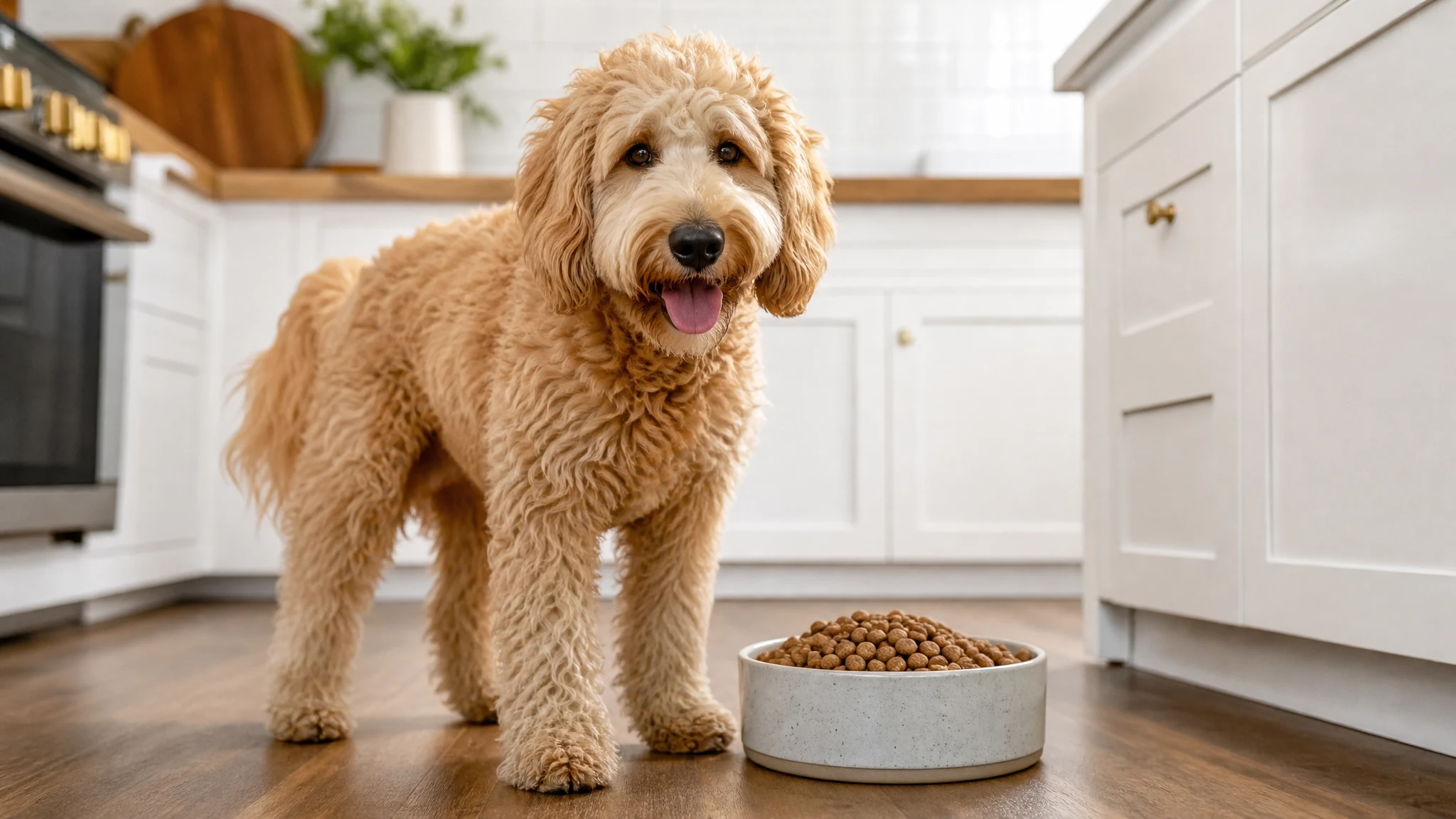
General nutrition information compiled from product labels and published sources, not veterinary advice. Your veterinarian is the right person to choose a diet for your dog, especially one with a health condition.
Many Goldendoodle owners ask about 4health dog food because it is easy to find and the bags look familiar. Few ask the better question: what does the label actually say, and does it fit a dog that could weigh 25 pounds or 70?
This guide shows you how to read and compare any dog food label for a Goldendoodle. It also sets out label data for several foods we can name with confidence. One caution first. We do not have verified label data for any specific 4Health formula, so we do not quote its numbers here. Use the checklist below with the bag in your hands, or with the label on the brand's own product page.
How we compared foods
We compared label data only. That means the AAFCO statement, life stage, first ingredients, minimum protein and fat where the brand prints them, and calories. We did not run feeding trials or taste tests, and we have not fed these foods to dogs. Nothing here says one food is better for your dog than another. It shows what each label claims, so you can ask better questions.
If you want a wider comparison across brands, see our label-by-label Goldendoodle food comparison.
Start with your Goldendoodle's size
The Goldendoodle is a Golden Retriever and Poodle cross. There is no kennel-club standard for it. The Goldendoodle Association of North America (GANA), a breeder association, publishes its own size categories based on height:
- Petite Mini: under 14 inches, typically 25 lb or less
- Mini: 14 to 17 inches, typically 26 to 35 lb
- Medium: 17 to 21 inches, typically 36 to 50 lb
- Standard: over 21 inches, typically 51 lb or more
Size depends on the Poodle parent and on the generation, so these are ranges, not promises. Some standards can reach the 70 lb mark that AAFCO uses for its large-size growth wording. Ask your breeder or veterinarian what adult weight to expect for your puppy.
This matters because food labels are written by size. A formula for a 15 lb adult and one for a 65 lb puppy are not interchangeable just because both say "dog food."
What to look for on any label
1. The AAFCO nutritional adequacy statement
Look for a sentence saying the food is "complete and balanced" for a stated life stage. It is the most important line on the bag. It will say either that the food is formulated to meet AAFCO nutrient profiles, or that animal feeding tests using AAFCO procedures substantiate it. Both are legitimate routes. They are different claims, so note which one you are reading.
2. Life stage
Puppy, adult maintenance, or all life stages. A growing puppy needs a food labelled for growth or all life stages. An adult dog on a puppy food may take in more calories than needed.
3. The large-size growth wording
Per the Merck Veterinary Manual, a food labelled for growth or all life stages must say either "including growth of large-size dogs (70 lb or more as an adult)" or "except for growth of large-size dogs." The "including" wording means the food meets the AAFCO nutrient levels set for large-size growing dogs, which currently applies only to calcium. The Merck manual also notes that excess calcium is a bigger concern for large-breed puppies. This is most relevant to standard Goldendoodles. Mini and petite sizes are small dogs.
4. First ingredients
Ingredients are listed by weight before cooking, so the first five tell you the base of the recipe. Read them as a description, not a grade. A named meat first is easy to understand. "By-product meal" or "meal" is a legal, defined ingredient, not automatically a flaw. What you want is clarity about what the food is made from.
5. Guaranteed analysis
This gives minimum crude protein and fat and maximum fiber. Comparing across foods only works when the numbers are on the same basis. Some brands, including Hill's on its product pages, show dry-matter averages instead. Those figures are not the same as a bag's guaranteed analysis, so do not line them up as if they were.
6. Calories per cup
Calories decide how much you feed. Two foods that look alike can differ by 50 calories a cup or more. Feeding a Goldendoodle by cup count without checking calories is a common way to overshoot.
Key features to compare
The table below shows the label data we could confirm for foods that suit Goldendoodle sizes. None is a Goldendoodle-specific formula. No such formula turned up in the sources we reviewed. "Not listed" means the brand page did not show that figure in the form we could use.
| Food | Form | Life stage and size | First ingredients | Min protein / fat | Calories |
|---|---|---|---|---|---|
| Royal Canin Size Health Nutrition Large Puppy | Dry | Large puppies, adult weight 56 to 100 lb, up to 15 months | Chicken by-product meal, corn, wheat, chicken fat, wheat gluten | 28% / 14% | 349 kcal ME per cup |
| Hill's Science Diet Puppy Large Breed Chicken & Brown Rice | Dry | Large puppies, over 55 lb as adults, up to 18 months | Chicken, brown rice, whole grain oats, chicken meal, cracked pearled barley | Not listed (dry-matter averages: 26.3% / 15.4%) | 391 kcal per cup |
| Hill's Science Diet Puppy Small & Mini Chicken & Brown Rice | Dry | Small and mini puppies, up to 1 year | Chicken, whole grain oats, brown rice, chicken meal, chicken fat | Not listed (dry-matter averages: 28.9% / 19.7%) | 418 kcal per cup |
| Royal Canin Size Health Nutrition Medium Adult | Dry | Adults 23 to 55 lb, over 12 months | Brewers rice, chicken by-product meal, oat groats, wheat, corn protein meal | 23% / 12% | 340 kcal ME per cup |
| Royal Canin Size Health Nutrition Large Adult | Dry | Adults 56 to 100 lb, over 15 months | Chicken by-product meal, brewers rice, wheat, brown rice, chicken fat | 24% / 15% | 360 kcal ME per cup |
| JustFoodForDogs Chicken & Rice | Fresh, frozen | All life stages, including large-size growth | Chicken, long-grain white rice, long-grain brown rice, carrots, kale | 8% / 3% | 43 kcal ME per oz (not stated per cup) |
| Nom Nom Turkey Fare | Fresh | All life stages, including large-size growth | Ground turkey, brown rice, egg, carrots, spinach | 9% / 4% | 244 kcal per cup |
Fresh foods list lower protein and fat percentages because they contain much more water. Do not compare their guaranteed analysis directly to kibble. Compare calories and the AAFCO statement instead.
Label picks by dog, not by price
We have no verified prices for any of these foods, and prices change by store and region, so we will not rank by cost. Instead, here is how the labels line up with different Goldendoodle situations. Check the brand's page for current pricing.
Standard Goldendoodle puppies
Royal Canin Large Puppy states it is formulated for growth "including growth of large size dogs (70 lb. or more as an adult)." Hill's Puppy Large Breed is substantiated by animal feeding tests using AAFCO procedures. Its page statement does not carry the "including growth of large-size dogs" phrase. Both are labelled for large-breed puppies, but the claims are worded differently. Royal Canin's page gives a puppy window up to 15 months. Hill's gives up to 18 months. Your veterinarian can tell you when to switch for your dog.
Mini and petite Goldendoodle puppies
Hill's Puppy Small & Mini is labelled for puppies up to 1 year, with a feeding-test AAFCO statement. At 418 kcal per cup it is the most calorie-dense kibble in the table, so measure carefully with a small dog.
Adult Goldendoodles
Match the formula to your dog's adult weight. Royal Canin Medium Adult covers 23 to 55 lb. Royal Canin Large Adult covers 56 to 100 lb. Both state they meet AAFCO profiles for maintenance. A mini at 30 lb and a standard at 65 lb would sit in different categories.
Fresh food
JustFoodForDogs Chicken & Rice and Nom Nom Turkey Fare both state they meet AAFCO profiles for all life stages, including growth of large-size dogs. Both are shipped or stored frozen. The brands say to thaw in the refrigerator and use within 5 days of opening or defrosting. Nom Nom calculates portions per dog from the owner's information.
Wet food
Hill's Science Diet Adult Chicken & Barley Entree comes in a 13 oz can with a feeding-test maintenance statement. Its page lists 369 kcal per can. It is labelled for adults 1 to 6 years of age, with no size restriction.
Where 4Health fits
Hold any 4Health bag up against the same checklist. Find the AAFCO statement. Check whether it says "growth," "maintenance" or "all life stages." If the dog is a standard-size puppy, look for the "including growth of large-size dogs" wording. Read the first five ingredients. Write down calories per cup, then compare them with the table above.
We cannot say how 4Health compares until you do that, and we will not guess. Check the brand for the current label on the specific formula you are considering, because recipes and names change.
Red flags to avoid
- No AAFCO statement at all. Without one, you cannot tell whether the food is complete and balanced.
- Wrong life stage. Maintenance-only food for a growing puppy, or "except for growth of large-size dogs" on a food for a standard Goldendoodle puppy.
- Vague breed claims. "Perfect for doodles" on the front of a bag means nothing. No Goldendoodle formula was found in the sources we used. Judge the back panel.
- No calories listed. A food that hides calories makes safe portioning harder.
- Health promises. A food cannot prevent or treat hip dysplasia, allergies, bloat or heart disease. Only a veterinarian can address a condition, and prescription diets come only from a veterinarian.
- Marketing that does the thinking for you. "Premium," "natural" and "holistic" are not defined the way the AAFCO statement is.
A note on grain-free and heart disease
Goldendoodles can inherit traits from their Golden Retriever parent. A UC Davis School of Veterinary Medicine study reported taurine-deficient dilated cardiomyopathy (DCM) in golden retrievers, and 23 of 24 had been fed grain-free, legume-rich or combination diets, according to a 2019 UC Davis news release. The U.S. FDA began investigating reports of DCM in dogs eating certain foods in July 2018, many labelled grain-free with peas, lentils, other pulses or potatoes among the first 10 ingredients. FDA's most recent public update is dated December 23, 2022, and it says it will not release further updates until there is meaningful new science.
That does not prove grain-free food causes DCM, and we are not saying so. It is a reason to read the first ingredients and to talk to your veterinarian before choosing a grain-free formula. Every food in the table above is labelled as not grain-free.
Where to buy
Buy from a source that lets you read the full label before you commit. Start with the brand's own product page, where the AAFCO statement, ingredient list and calorie content are posted. Compare that against the bag at your store of choice. Then check the lot or best-by date on the package.
We do not link to retailers. For the foods above, the manufacturer pages are listed in the Sources section. For 4Health, check the brand directly for its current formulas and label details.
When you switch foods, do it gradually over about a week, mixing increasing amounts of the new food into the old. Treat any feeding chart as a starting point, and adjust to your dog's body condition. The AKC notes some Golden Retrievers can become overweight, and Goldendoodles can inherit that tendency. Your veterinarian decides what is right for an individual dog.
Questions to bring to your veterinarian
- What adult weight should I plan for, and when should my puppy move to an adult food?
- Does this formula's AAFCO statement suit my dog's size and age?
- How many calories a day should my dog eat right now?
- Are there health screening results from the parents that should affect food choices?
Sources
- Goldendoodle Association of North America, Goldendoodle Breed Standard
- Merck Veterinary Manual, Dog and Cat Foods
- Merck Veterinary Manual, Nutritional Requirements of Small Animals
- U.S. FDA, Investigation into Potential Link between Certain Diets and Canine Dilated Cardiomyopathy
- UC Davis, Dogs Fed Some Popular Diets Could Be at Risk of Heart Disease
- American Kennel Club, Golden Retriever
- Royal Canin, Large Puppy
- Royal Canin, Medium Adult
- Royal Canin, Large Adult
- Hill's Science Diet, Puppy Large Breed
- Hill's Science Diet, Puppy Small & Mini
- Hill's Science Diet, Adult Chicken & Barley Entree
- JustFoodForDogs, Chicken & Rice Recipe
- Nom Nom, Turkey Fare