What Makes a Dog Food Good for a Goldendoodle: A Label-Reading Guide
General nutrition information compiled from product labels and published sources, not veterinary advice. Your veterinarian is the right person to choose a diet for your dog, especially one with a health condition.
Every bag claims to be the best dog food for goldendoodles. Few say anything specific about a dog that can weigh 20 pounds or 70. This guide shows you how to read a label and judge a food on what is printed, not on what the front of the bag implies.
It is a method, not a ranking. We compared label data published by the brands. We did not run feeding trials or taste tests, and we are not telling you which food to buy. A veterinarian decides what suits an individual dog.
What you need before you start
- Your dog's age and a recent weight from your veterinarian's scale.
- Your dog's expected adult size, if you have a puppy. Ask the breeder what the Poodle parent was (Toy, Miniature or Standard).
- The bag or the brand's product page for each food you are considering.
- A pen and paper, or a simple note on your phone, to compare foods side by side.
- A scoop or kitchen scale, so you can measure what you feed.
For a broader look at what shapes a Goldendoodle's diet, see Goldendoodle nutrition and the diet factors that matter.
Step 1: Work out your Goldendoodle's size
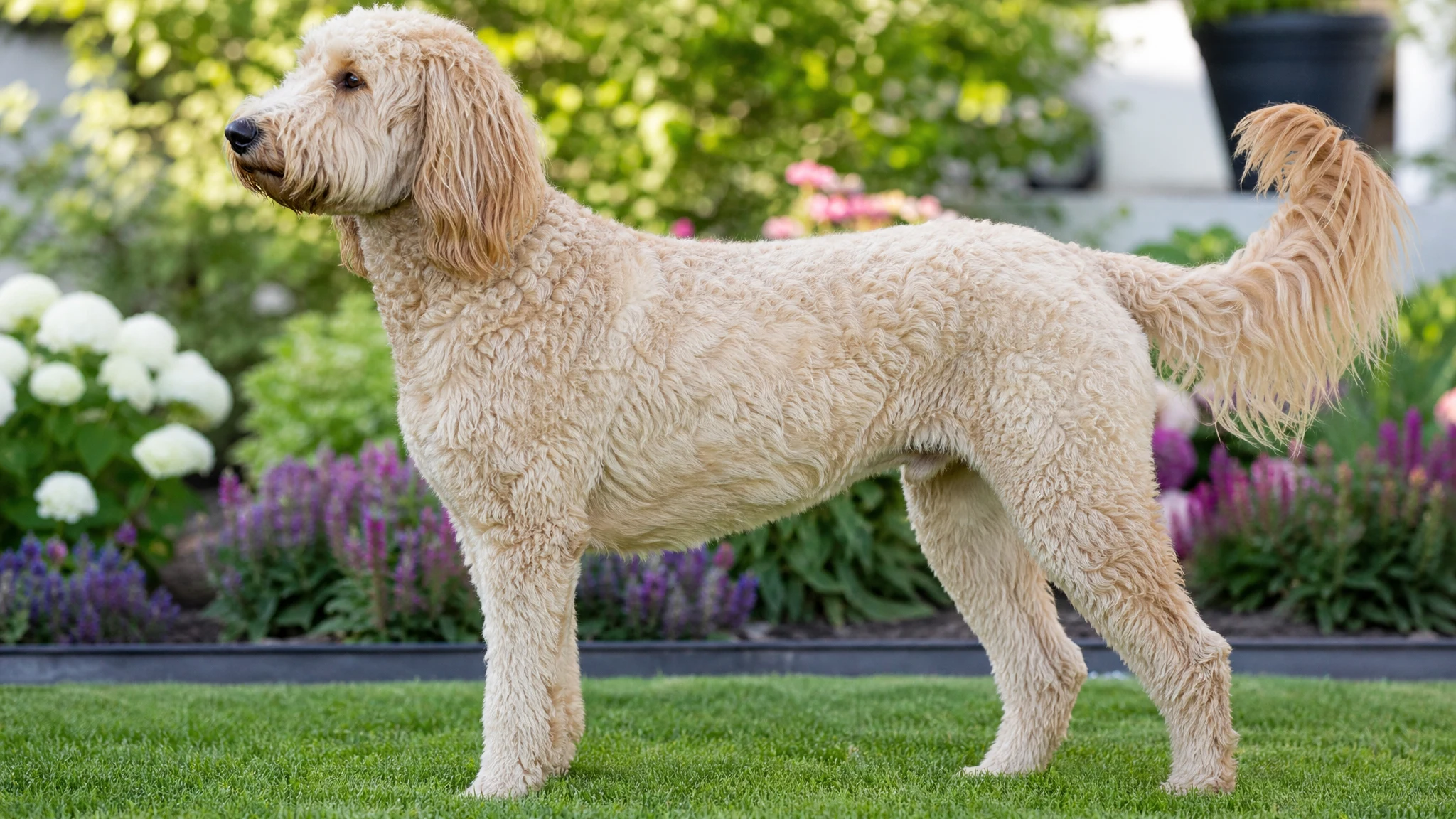
Goldendoodles come in a wide range of sizes, so "Goldendoodle food" is really a size question. The Goldendoodle Association of North America (GANA), a breeder association rather than a kennel club, describes four sizes by height. Its typical weights are:
- Petite Mini: under 14 inches, typically 25 lb or less
- Mini: 14 to 17 inches, typically 26 to 35 lb
- Medium: 17 to 21 inches, typically 36 to 50 lb
- Standard: over 21 inches, typically 51 lb or more
These are ranges, not promises. Size depends on the Poodle parent and on the generation. No kennel club publishes a Goldendoodle standard, and the American Kennel Club has no Goldendoodle breed page. So treat any exact adult weight with caution.
Standard Goldendoodles are the ones most likely to approach the 70 lb line that matters for puppy food labels (see Step 2). Minis and petites are small dogs and are better matched to small-breed formulas.
Step 2: Find the AAFCO statement
Turn the bag over and look for the "nutritional adequacy statement." It tells you two things: whether the food is complete and balanced, and for which life stage. Common wordings include "growth," "maintenance" and "all life stages."
For a puppy, there is an extra detail. The Merck Veterinary Manual explains that a food labelled for growth or all life stages must add one of two phrases:
- "including growth of large-size dogs (70 lb or more as an adult)"
- "except for growth of large-size dogs (70 lb or more as an adult)"
The "including" wording means the food meets the nutrient levels AAFCO sets for large-size growing dogs, which currently applies only to calcium. The Merck Manual also notes that excess calcium is more of a concern for growing large- and giant-breed dogs. That is why this phrase matters most for a Standard Goldendoodle puppy.
Read the wording exactly as printed. Here are a few examples from brand pages:
- Royal Canin Size Health Nutrition Large Puppy states it is formulated for growth "including growth of large size dogs (70 lb. or more as an adult)."
- Hill's Science Diet Puppy Large Breed uses a feeding-test statement instead. It says animal feeding tests using AAFCO procedures substantiate complete and balanced nutrition for growing puppies. The page statement does not include the "including growth of large-size dogs" phrase, so check with Hill's or your veterinarian if you have questions about it.
- JustFoodForDogs Chicken & Rice Recipe and Nom Nom Turkey Fare both state all life stages, including growth of large size dogs (70 lb. or more as an adult).
Do not infer more than the label says. A statement is a starting point for your comparison, not a verdict.
Step 3: Match the life stage and size on the bag
Brands set their own age and size ranges, and they differ. Compare them against your dog, not against a breed name.
- Royal Canin labels its Large Puppy food for large-breed puppies with an adult weight of 56 to 100 lb, up to 15 months old.
- Hill's labels its Puppy Large Breed food for large-breed puppies (over 55 lb as adults) up to 18 months old.
- Hill's Puppy Small & Mini is labelled for puppies up to 1 year old, which may suit a petite or mini doodle.
- Royal Canin Medium Adult is for dogs of 23 to 55 lb, over 12 months old.
- Royal Canin Large Adult is for dogs of 56 to 100 lb, over 15 months old.
A Medium Goldendoodle sits between categories. That is a good question for your veterinarian, who can look at your dog's weight and body condition.
Step 4: Read the first five ingredients
Ingredients are listed by weight before cooking. The first five show the main building blocks of the recipe. They do not tell you the whole nutritional story, and a long list of appealing words does not make a food better.
Some label examples:
- Royal Canin Large Puppy: chicken by-product meal, corn, wheat, chicken fat, wheat gluten.
- Hill's Puppy Large Breed: chicken, brown rice, whole grain oats, chicken meal, cracked pearled barley.
- JustFoodForDogs Chicken & Rice: chicken, long-grain white rice, long-grain brown rice, carrots, kale.
- Nom Nom Turkey Fare: ground turkey, brown rice, egg, carrots, spinach.
Notice that a meal or a by-product meal is not automatically worse or better than a named fresh meat. Water in fresh meat weighs a lot, which is why fresh foods list whole meat first. Compare foods on the nutrient numbers as well (Step 5).
A note on grain-free and heart health
Golden Retrievers are one of the parent breeds, so this topic comes up often. A UC Davis School of Veterinary Medicine study, described in a January 2019 news release, found taurine-deficient dilated cardiomyopathy (DCM) in golden retrievers. Of 24 dogs, 23 had been fed grain-free, legume-rich or combination diets.
The U.S. FDA began investigating reports of DCM in dogs eating certain foods in July 2018. Many were labelled grain-free, with peas, lentils, other pulses or potatoes among the first ten ingredients. FDA's most recent public update is dated December 23, 2022, and it said it did not plan further public updates until there is meaningful new scientific information.
That does not show that grain-free food causes DCM, and it does not show that any food prevents it. A fair, cautious approach is to look at the ingredient list for heavy use of pulses, and to raise the question with your veterinarian before choosing a grain-free diet. All the foods listed in this guide are labelled as not grain-free.
Step 5: Compare the numbers fairly
The guaranteed analysis lists minimum protein and fat and maximum fiber on an as-fed basis. Water content changes those numbers, so a canned or fresh food will look low in protein next to a kibble even when it is not.
Hill's product pages show average nutrients on a dry-matter basis instead of a guaranteed analysis. Do not put those figures next to another brand's as-fed numbers. Compare like with like, or ask the brand for dry-matter values.
| Food (brand label data) | Protein | Fat | Fiber | Energy |
|---|---|---|---|---|
| Royal Canin Large Puppy (dry) | 28.0% min | 14.0% min | 3.7% max | 349 kcal ME per cup |
| Royal Canin Medium Adult (dry) | 23.0% min | 12.0% min | 3.4% max | 340 kcal ME per cup |
| Royal Canin Large Adult (dry) | 24.0% min | 15.0% min | 3.2% max | 360 kcal ME per cup |
| JustFoodForDogs Chicken & Rice (fresh) | 8.0% min | 3.0% min | 1.0% max | 43 kcal ME per oz |
| Nom Nom Turkey Fare (fresh) | 9% min | 4% min | 4% max (dietary fiber) | 244 kcal per cup |
| Hill's Puppy Large Breed (dry, dry-matter averages) | 26.3% | 15.4% | 2.4% crude | 391 kcal per cup |
The fresh foods look low because they contain a lot of water. The Hill's row is on a different basis and is not directly comparable to the others. Brands do not list kibble size on the pages we compared, so check the bag or ask the brand if size matters for your dog.
Step 6: Check calories and feeding amounts
Calories per cup vary a lot. Royal Canin Medium Adult lists 340 kcal ME per cup. Hill's Puppy Small & Mini lists 418 kcal per cup. A cup is not a cup across brands.
The American Kennel Club notes that some Golden Retrievers can become overweight, and Goldendoodles can inherit that tendency. So treat feeding guides as starting points. Hill's own page says to adjust amounts to maintain optimal weight and to ask your veterinarian if unsure.
Practical points:
- Measure with a scoop or scale, not by eye.
- Count treats and chews in the day's total.
- Re-check your dog's weight and body condition with your veterinarian on a schedule they suggest.
- For fresh foods, follow the brand's storage rules. Nom Nom and JustFoodForDogs both describe freezing and a limited fridge life after thawing, and Nom Nom portions each meal for the individual dog from the details you provide.
Step 7: Consider your dog's inherited risks, then ask your vet
Health information here comes from the parent breeds, because no source documents these conditions for Goldendoodles as such. Goldendoodles can inherit tendencies from either side:
- Hip and elbow dysplasia, which the AKC says Golden Retriever breeders screen for. GANA requires hip, elbow, heart, patella and eye results submitted to OFA for its breeders.
- Bloat (gastric dilatation with volvulus), which the AKC says Standard Poodles are more at risk for.
- Pancreatitis, which the Merck Veterinary Manual says has a reported increased prevalence in Poodles.
- Liver conditions such as portosystemic shunts (more common in large breeds including Golden Retrievers) and hepatoportal microvascular dysplasia (reported in Toy and Miniature Poodles), per the Merck Veterinary Manual.
No dog food prevents, treats or cures any of these. Diet is one part of the picture, and a veterinarian decides what suits an individual dog. Prescription diets are only something a veterinarian prescribes. If your dog has a diagnosis, follow your veterinarian's plan rather than a label.
Tips and common mistakes
- Mistake: choosing by the breed name. No Goldendoodle-specific commercial formula turned up in our label comparison. Foods are sized, so choose by your dog's expected adult weight.
- Mistake: assuming every puppy food suits a large puppy. Look for the "including growth of large-size dogs" wording, or ask the brand how the food covers large-size growth.
- Mistake: comparing as-fed and dry-matter numbers. Check the basis before comparing protein or fat.
- Mistake: treating the first ingredient as the whole story. Read the statement, the numbers and the calories too.
- Mistake: switching foods overnight. Ask your veterinarian how to transition, since sudden changes can upset some dogs' stomachs.
- Tip: keep a note of the product name, the statement and the calories per cup for each food you consider. Foods and labels change, so recheck the brand page before you buy.
- Tip: use a size-based chart rather than the age in months. Brands set "adult" at 12, 15 or 18 months, depending on size.
What to expect
Done carefully, this process can help you narrow a crowded shelf down to a few foods that fit your dog's size and life stage. It may also make the choice feel less confusing, and it gives you specific questions to bring to your veterinarian.
It will not identify one perfect food for every Goldendoodle, and a label cannot predict how your dog will do. Watch your dog's weight, energy, stool and coat over the weeks after a change, and report concerns to your veterinarian. Results vary from dog to dog.
The best dog food for goldendoodles is the one that matches your dog's size and life stage, carries a clear AAFCO statement, fits your dog's calorie needs, and is approved by your veterinarian for your dog.
Sources
- Goldendoodle Association of North America, Goldendoodle Breed Standard
- Goldendoodle Association of North America, Health Testing Standards
- Merck Veterinary Manual, Dog and Cat Foods
- Merck Veterinary Manual, Nutritional Requirements of Small Animals
- Merck Veterinary Manual, Pancreatitis in Dogs and Cats
- Merck Veterinary Manual, Congenital and Inherited Anomalies of the Liver in Animals
- UC Davis, Dogs Fed Some Popular Diets Could Be at Risk of Heart Disease
- U.S. FDA, Investigation into Potential Link between Certain Diets and Canine Dilated Cardiomyopathy
- American Kennel Club, Golden Retriever
- American Kennel Club, Poodle (Standard)
- Royal Canin US, Large Puppy Dry Dog Food
- Royal Canin US, Medium Adult Dry Dog Food
- Royal Canin US, Large Adult Dry Dog Food
- Hill's Pet Nutrition, Science Diet Puppy Large Breed
- Hill's Pet Nutrition, Science Diet Puppy Small & Mini
- JustFoodForDogs, Chicken & Rice Recipe
- Nom Nom, Turkey Fare