Dog Probiotics for Gut Health: What the Evidence Says for Goldendoodles
General nutrition information compiled from product labels and published sources, not veterinary advice. Your veterinarian is the right person to choose a diet for your dog, especially one with a health condition.
Probiotics are everywhere in the pet aisle. Chews, powders, toppers and kibble coatings all promise a calmer gut. If you share your home with a Goldendoodle, it is fair to ask whether any of it is worth your money.
This guide walks through a careful way to think about dog probiotics for gut health. It is a decision process, not a product pitch. It is also honest about what we can and cannot say. The sources used here describe Goldendoodle size, parent-breed health notes and food labels. None of them shows that a particular probiotic works in Goldendoodles. So you will not find promises below.
What probiotics are, and what we can and cannot say
Probiotics are live microorganisms sold to be given with food. Some are sold as stand-alone supplements. Others are added to dog food by the maker.
Here is the limit of this page. The sources behind it do not include a Goldendoodle trial of any probiotic. No source documents gut conditions in Goldendoodles as a breed. So we will not say a probiotic helps, treats or prevents any digestive problem. Anyone who tells you it will fix your dog's gut should be asked for the study.
What we can do is lay out what is known about the breed's background and how to run a sensible, low-risk trial with your veterinarian in charge.
Why the Goldendoodle's parentage matters
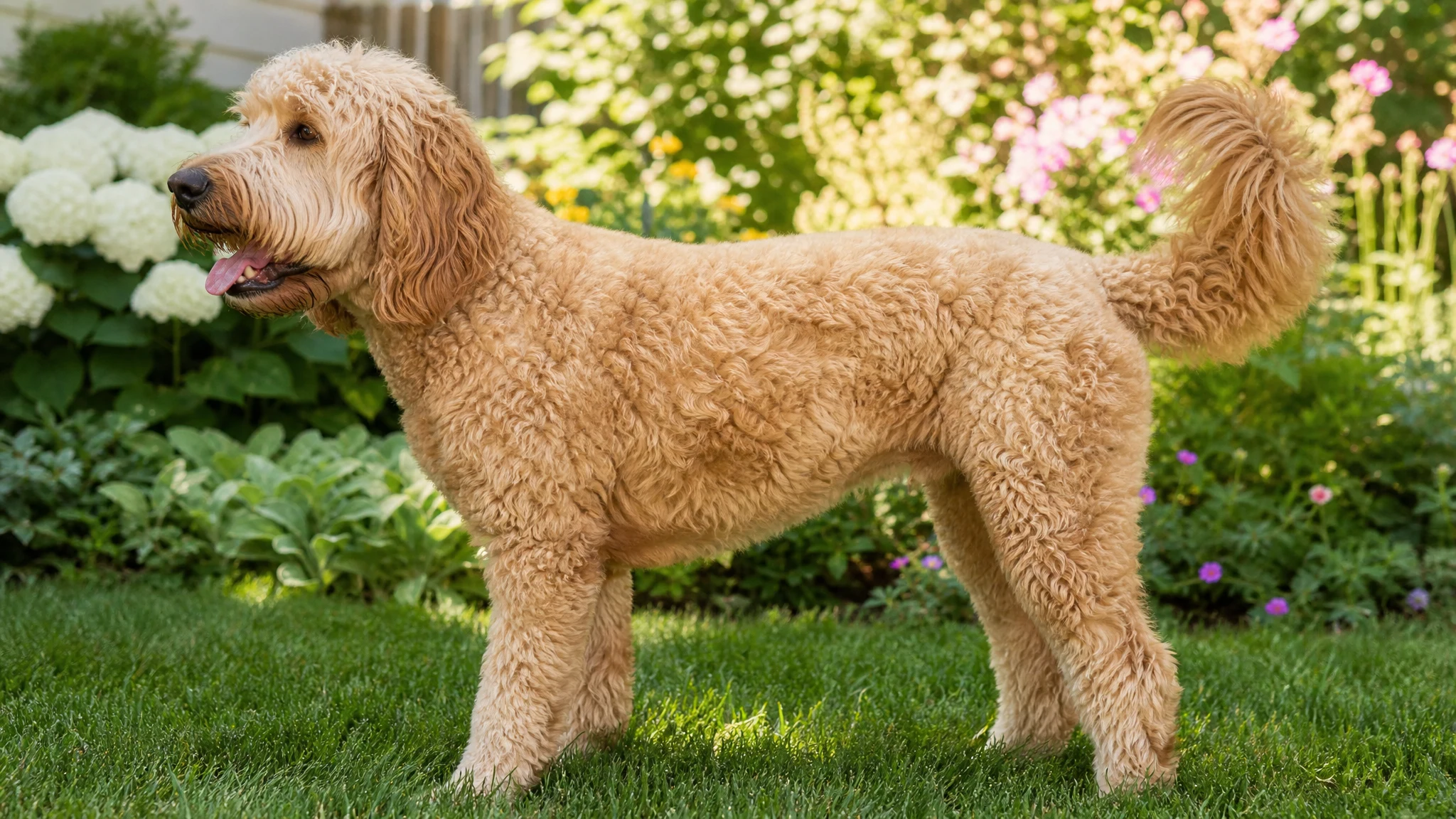
The Goldendoodle is a Golden Retriever and Poodle cross. The Goldendoodle Association of North America (GANA) describes it as not a conformation show breed, and it has no kennel-club standard. GANA is a breeder association, so its standard is self-published.
Size varies a great deal. GANA lists these typical adult weights, and says height decides the size category:
- Petite Mini: under 14 inches, typically 25 lb or less
- Mini: 14 to 17 inches, typically 26 to 35 lb
- Medium: 17 to 21 inches, typically 36 to 50 lb
- Standard: over 21 inches, typically 51 lb or more
Health notes come from the parent breeds, not from Goldendoodle studies. So the careful wording is that a Goldendoodle can inherit certain tendencies. Three are relevant to the gut:
- The Merck Veterinary Manual reports that Poodles are among the breeds with an increased prevalence of pancreatitis.
- The American Kennel Club (AKC) Standard Poodle page says Standard Poodles are more at risk for gastric dilatation with volvulus, also called bloat.
- The AKC Golden Retriever page notes that some Golden Retrievers can become overweight.
These notes are the reason to bring your veterinarian in before you add anything new. They are not a sign your dog has any of these problems. Sudden vomiting, a swollen belly, repeated retching or severe pain is an emergency visit, not a supplement trial.
Materials you will need
You do not need much. Gather these before you begin:
- The full label of your dog's current food, including the ingredient list and the AAFCO statement
- The label or product page of any probiotic you are considering
- A notebook or phone notes app for a simple daily log
- A kitchen scale or a marked measuring cup, so portions stay the same
- Your veterinarian's contact details
Step by step: how to approach a probiotic trial
Step 1: Rule out a medical problem first
Loose stools, gas and a rumbling belly can come from many causes. These include a diet change, a food the dog should not have eaten, parasites or illness. A supplement cannot sort these out. Book a visit if the signs last more than a day or two, if your dog seems tired, or if there is blood or repeated vomiting.
Puppies and small dogs can get into trouble faster, so do not wait on them.
Step 2: Get the base diet right before adding anything
The simplest gut-friendly step is a steady, complete and balanced food. Check that the label carries an AAFCO statement for your dog's life stage and size. Our guide to Goldendoodle nutrition and the diet factors that matter covers how to read these labels.
Size matters here. For a puppy expected to reach 70 lb or more, the Merck Veterinary Manual says the label should read "including growth of large-size dogs (70 lb or more as an adult)." Some Standard Goldendoodles can reach that threshold. Mini and petite sizes are small dogs, so a small-breed puppy food may be the better match.
Here is how a few foods describe themselves on their own pages. We compared label data only. We did not run feeding trials or taste tests.
| Food | Label statement type | First ingredient listed | Calories as listed |
|---|---|---|---|
| Royal Canin Large Puppy (dry) | Growth, including large-size dogs (70 lb or more as an adult) | Chicken by-product meal | 349 kcal ME per cup |
| Hill's Science Diet Puppy Large Breed (dry) | AAFCO feeding-test claim for growing puppies; the page does not carry the "including growth of large-size dogs" phrase | Chicken | 391 kcal per cup |
| Hill's Science Diet Puppy Small & Mini (dry) | AAFCO feeding-test claim for growing puppies | Chicken | 418 kcal per cup |
| Royal Canin Medium Adult (dry) | Maintenance | Brewers rice | 340 kcal ME per cup |
This table is not a ranking, and it says nothing about gut effects. The pages we drew on do not list probiotics for these foods. If you want to know whether a food contains added probiotics, check the brand's own page or ask the brand.
Step 3: Ask your veterinarian whether a probiotic fits your dog
Bring your notes and the product label. Ask these questions:
- Is there a reason to avoid a probiotic for my dog, given its age, size and history?
- Which product do you would suggest, and why?
- How long should the trial last before we decide?
- What signs mean I should stop and call you?
Dose and duration are your veterinarian's call, and the product's own label is where its directions live. We do not give amounts here.
Step 4: Read the probiotic label like a food label
Be skeptical of marketing words such as "digestive support" or "gut health formula." They are not a promise of any result. Look for:
- A named maker with a way to contact them
- A clear ingredient list, including any flavorings or fillers
- Directions that are written for dogs, and for your dog's weight
- Storage instructions, since live products can be sensitive to heat and moisture
Check any claim the maker makes against what they can show. Ask for the source. Do not rely on star ratings or testimonials, which tell you little about whether a product is suitable.
Step 5: Change one thing at a time
Do not switch food, add a probiotic and start new treats in the same week. If your dog's stool changes, you will not know why. Keep the food, the portions and the treats steady. Then add only the probiotic, in the way your veterinarian and the label direct.
Step 6: Keep a simple log
Write down a few things each day:
- Appetite and energy
- Stool quality, using a plain description or a score your vet gives you
- Any vomiting, gas or belly noises
- Treats or table scraps eaten
A log makes the veterinary follow-up far more useful than memory does.
Step 7: Review with your veterinarian and decide
At the end of the trial period, share the log. You may decide to continue, change course or stop. Stopping is a perfectly good result if nothing seems different. A supplement that makes no visible difference is an ongoing cost you can drop.
Common mistakes to avoid
- Treating a probiotic as a cure. No source here shows a probiotic or any food treats or prevents bloat, pancreatitis or any other condition. A veterinarian decides for the individual dog.
- Starting during a flare-up without a diagnosis. Persistent digestive signs need an exam first.
- Switching foods too fast. A sudden diet change can upset the gut by itself.
- Adding calcium or other supplements to a growing large puppy. The Merck Veterinary Manual says excess calcium is a bigger problem for growing large and giant-breed dogs, and that over-supplementation worsens bone and cartilage signs in rapidly growing large-breed dogs. Ask your veterinarian before adding any mineral product to a Standard Goldendoodle puppy's diet.
- Chasing a grain-free label for gut reasons. The U.S. FDA began investigating reports of dilated cardiomyopathy (DCM) in dogs eating certain foods in July 2018. Many were labeled grain-free, with peas, lentils, other pulses or potatoes among the first 10 ingredients. FDA's latest public update is dated December 23, 2022, and it said it does not plan more public updates until there is meaningful new science. A UC Davis study in 2019 found taurine-deficient DCM in golden retrievers, 23 of 24 of whom had been fed grain-free, legume-rich or combination diets. This does not show that grain-free food causes DCM. It is one more reason to talk with your veterinarian about the whole diet.
- Ignoring weight. Some Golden Retrievers can become overweight, according to the AKC. Probiotic chews and toppers add calories, so count them in the daily total.
- Leaving fresh food out. If you feed a fresh food, follow its storage rules. For example, Nom Nom says to keep defrosted meals in the fridge for up to 5 days. JustFoodForDogs says to use opened food within 5 days. Check each brand's page for the full handling directions.
Expected results, honestly stated
Results vary from dog to dog, and no result is guaranteed. Some owners notice firmer or more regular stools during a trial. Others see no change at all. Because Goldendoodles come in many sizes and mixes, there is no standard timeline or expected outcome that we can cite.
Any change you see could also come from the steady routine you adopted, not the product. This is why changing one thing at a time matters, and why your veterinarian should interpret the log.
Probiotic products are sold as supplements, and these statements about them have not been evaluated as a way to treat or prevent disease. If your dog gets worse at any point, stop the product and call your veterinarian.
When to skip the trial and call the vet
- A swollen or hard belly, repeated unproductive retching or restlessness, which can signal bloat
- Repeated vomiting, severe belly pain or a hunched posture
- Blood in the stool or vomit
- Diarrhea lasting more than a day or two, especially in puppies and small dogs
- Refusing food, or marked tiredness
Key takeaways
- Start with a complete, balanced food that matches your Goldendoodle's size and life stage.
- Treat probiotics as an optional extra, chosen with your veterinarian.
- Change one thing at a time and keep a log.
- Be wary of any claim to treat, prevent or cure a condition.
- Check with the brand for anything this page does not list, such as strains, storage and added probiotics.
Sources
- Goldendoodle Association of North America, Goldendoodle Breed Standard
- American Kennel Club, Golden Retriever breed page
- American Kennel Club, Poodle (Standard) breed page
- Merck Veterinary Manual, Pancreatitis in Dogs and Cats
- Merck Veterinary Manual, Dog and Cat Foods
- Merck Veterinary Manual, Nutritional Requirements of Small Animals
- U.S. FDA, Investigation into Potential Link between Certain Diets and Canine Dilated Cardiomyopathy
- UC Davis, Dogs Fed Some Popular Diets Could Be at Risk of Heart Disease
- Royal Canin US, Large Puppy Dry Dog Food
- Hill's Pet Nutrition, Science Diet Puppy Large Breed