Preparing Your Goldendoodle's Meals: A Step-by-Step Routine
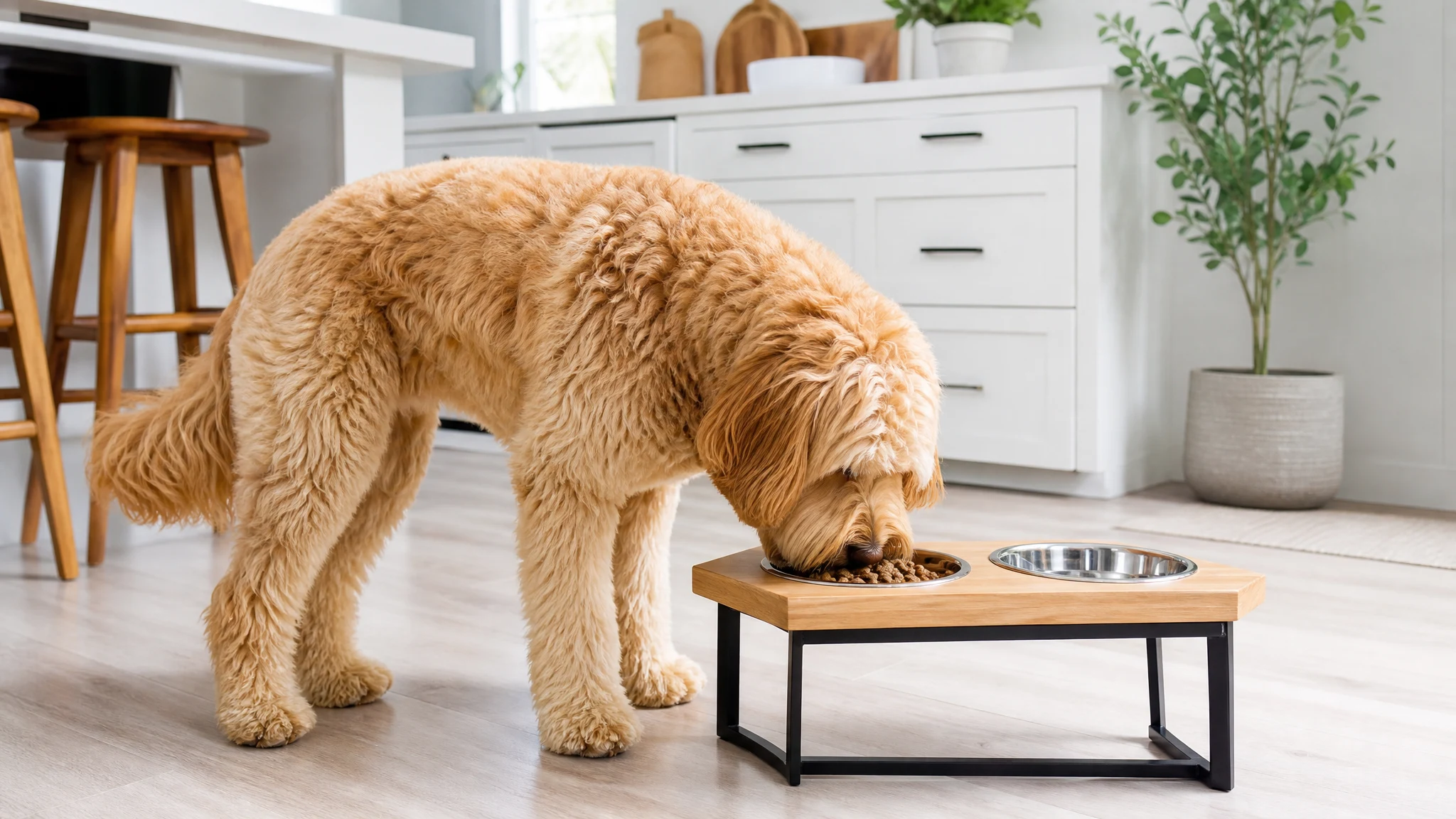
General nutrition information compiled from product labels and published sources, not veterinary advice. Your veterinarian is the right person to choose a diet for your dog, especially one with a health condition.
A good meal routine is mostly habit. You pick a food with a label that fits your dog's size and age, measure it the same way each time, store it safely and watch how your dog does. This guide walks through that dog feeding preparation routine one step at a time.
Goldendoodles vary a lot. The Goldendoodle Association of North America (GANA), a breeder association and not a kennel club, groups them by height. It lists Petite Mini as typically 25 lb or less, Mini as 26-35 lb, Medium as 36-50 lb and Standard as 51 lb or more. Your dog's routine depends on which of those your dog is.
What You Need Before You Start
- The food bag, can or fresh-food pack, with its full label.
- A dry measuring cup, or a kitchen scale that reads in grams.
- A clean bowl, washed after each meal.
- An airtight container for dry food, if you keep it out of the original bag.
- Freezer and refrigerator space, if you feed fresh food.
- A notebook or phone note for your dog's weight, amounts and appetite.
- Your veterinarian's contact details, for any question about your individual dog.
How We Compared Foods
We compared label data from the brands' own pages: the AAFCO statement, first ingredients, calories and the nutrient figures each brand prints. We did not run feeding trials or taste tests, and we did not feed any of these foods to dogs. Treat the examples below as ways to read a label, not as rankings or endorsements.
Step 1: Work Out Your Dog's Size Group
Start with what you know. Check your dog's current weight and age, and ask the breeder or your vet which size group fits. Size depends on the Poodle parent (Toy, Miniature or Standard) and on the generation, so every number is a range.
For context, the American Kennel Club (AKC) lists Golden Retrievers at 65-75 lb for males and 55-65 lb for females. It lists Standard Poodles at 60-70 lb for males and 40-50 lb for females, and Miniature Poodles at 10-15 lb. GANA notes that some Standard Goldendoodles can reach the 70 lb mark that AAFCO uses for "large-size" dogs. A dog's final size is hard to predict, so ask your vet for a growth check at puppy visits.
There is no AKC breed standard for the Goldendoodle. Brands also do not make a Goldendoodle-specific formula that we could verify. Most owners pick a size-based food instead.
Step 2: Read the Label for Life Stage
Find the AAFCO statement on the bag or product page. It tells you which life stage the food is built for.
- Growth: for puppies.
- Maintenance: for adults.
- All life stages: covers both.
For growth and all-life-stages foods, look for one more phrase. The Merck Veterinary Manual explains that these labels must say either "including growth of large-size dogs (70 lb or more as an adult)" or "except for growth of large-size dogs." The "including" wording means the food meets AAFCO's nutrient levels for large-size growing dogs, which currently applies only to calcium.
This matters most for Standard Goldendoodle puppies. The Merck Manual also notes that too much calcium is more of a concern for growing large-breed dogs. Mini and petite dogs are small dogs, so a small-breed puppy food may fit them better.
Examples of label wording
- Royal Canin Size Health Nutrition Large Puppy states it meets AAFCO profiles for growth "including growth of large size dogs (70 lb. or more as an adult)." Royal Canin labels it for large-breed puppies up to 15 months old.
- Hill's Science Diet Puppy Large Breed Chicken & Brown Rice Recipe cites AAFCO feeding tests. Its page statement does not carry the "including growth of large-size dogs" phrase. Hill's labels it for large-breed puppies up to 18 months old. Check with Hill's or your vet about what that means for your dog.
- Hill's Science Diet Puppy Small & Mini Chicken & Brown Rice Recipe is labeled for puppies up to 1 year old, which may suit smaller doodles.
- JustFoodForDogs Chicken & Rice Recipe and Nom Nom Turkey Fare, both fresh foods, state they are for all life stages including growth of large size dogs.
Report the statement as printed, and do not assume more than it says. A veterinarian decides what suits an individual dog.
Step 3: Read the Ingredients and Numbers
Look at the first five ingredients. They show what the recipe leans on most, by weight. For example, Royal Canin Large Puppy lists chicken by-product meal, corn, wheat, chicken fat and wheat gluten. Hill's Puppy Large Breed lists chicken, brown rice, whole grain oats, chicken meal and cracked pearled barley. These are plain facts about the recipes, not a verdict on either.
Next, note the protein, fat and fiber. Be careful when comparing, because brands print them differently:
- Royal Canin prints guaranteed analysis minimums. Large Puppy shows 28% protein minimum and 14% fat minimum.
- Hill's pages show dry-matter averages instead. For Puppy Large Breed that is 26.3% protein and 15.4% fat. These are not the same measure, so do not line them up as if they were.
- Fresh foods contain a lot of water, so their percentages look low. JustFoodForDogs Chicken & Rice lists 8% protein minimum and Nom Nom Turkey Fare lists 9%. That does not make them lower in protein in a meaningful way.
Compare like with like, or ask the brand for a dry-matter figure.
A note on grain-free labels
UC Davis reported taurine-deficient dilated cardiomyopathy (DCM) in golden retrievers, and 23 of 24 of those dogs had eaten grain-free, legume-rich or combination diets. Golden Retrievers are one parent breed of the Goldendoodle. The U.S. FDA began investigating diet-related DCM reports in July 2018 and published its latest update on December 23, 2022. Neither source says that grain-free food causes DCM. If you are weighing a grain-free diet, talk to your vet first.
Step 4: Find the Starting Amount
Use the feeding guide on the label as a starting point only. Guides assume an average dog, and your dog's activity, age and body condition may differ.
Here are a few printed examples, so you can see how much they vary:
- Royal Canin Large Adult lists 2 cup + 7/8 cup (274 g) per day for a 57 lb dog with low activity.
- Hill's Science Diet Adult Large Breed Chicken & Barley lists 3 1/4 cups (320 g) per day for a 50 lb dog.
- Hill's Adult 6+ Large Breed Chicken Meal, Barley & Rice lists 3 cups (295 g) per day for a 50 lb dog.
Calories per cup differ too. Hill's Adult Large Breed lists 365 kcal per cup, Hill's Adult 6+ Large Breed lists 352 kcal per cup, and Royal Canin Large Adult lists 360 kcal ME per cup. A cup of one food is not the same as a cup of another. For that reason, never swap foods and keep the old cup measure.
For fresh food, portions are usually set per dog. Nom Nom calculates portions from the details the owner provides. JustFoodForDogs lists 43 kcal ME per ounce for its Chicken & Rice Recipe. Follow each brand's own guidance.
For a breakdown by age, see our Goldendoodle feeding chart by age. If your dog has a health condition, confirm amounts with your veterinarian before you settle on a routine.
Step 5: Set the Meal Schedule
Split the day's total into equal portions. Royal Canin's page for Medium Adult recommends 2 to 4 equal portions per day. For puppies, how many meals to offer and when to move to fewer is a question for your vet at the next checkup.
Standard Poodles are listed by the AKC as more at risk for bloat (gastric dilatation with volvulus), and Standard Poodle is a possible parent. Ask your vet whether the number of meals, bowl type and activity timing around meals make sense for your dog. Do not guess.
Whatever schedule you choose, keep the times fairly steady. Dogs usually settle into a rhythm, and it makes appetite changes easier to spot.
Step 6: Measure Each Meal
- Level a dry measuring cup with a knife, or weigh the portion in grams. A scale is more consistent than a scoop, because kibble packs differently each time.
- Write the daily total on a note near the food. Everyone in the house should use the same number.
- Count treats and chews as part of the day's food. Reduce the meal slightly if you give many, and ask your vet how much.
- Do not top off "by eye."
The AKC notes that some Golden Retrievers can become overweight. Because it is a parent breed, measuring carefully is a sensible habit for a Goldendoodle too.
Step 7: Store and Handle the Food Safely
Dry food: keep it in a cool, dry place, sealed. Check the bag for the brand's storage guidance. Keeping the original bag inside a container keeps the lot information handy.
Fresh food: JustFoodForDogs says to store in the freezer, thaw in the refrigerator, and use within 5 days once opened. Nom Nom ships frozen or cold, asks you to thaw meal packs in the fridge overnight, and says to keep defrosted food in the fridge for up to 5 days.
Wet food: for example, Hill's Science Diet Adult Chicken & Barley Entree comes in a 13 oz can. Follow the storage directions on the can for leftovers.
Wash your hands and the bowl after each meal. Throw out food that has sat out or smells off.
Step 8: Serve, Watch and Adjust
Put the bowl down in a calm spot and let your dog eat at their own pace. Pick it up after the meal. Then check three things over the next couple of weeks:
- Appetite and energy.
- Stool quality.
- Body condition. You should be able to feel the ribs without pressing hard.
Weigh your dog on a regular schedule and note it. Hill's feeding guidance says to adjust amounts to maintain optimal weight and to ask your veterinarian if unsure. Adjust in small steps rather than big jumps.
Step 9: Change Foods Slowly
When you move up a life stage, such as from a puppy food to an adult food, do it over several days. Mix a little of the new food into the old, and raise the share gradually. Royal Canin labels its Medium Adult for dogs over 12 months, and its Large Adult for dogs over 15 months. The right moment depends on your dog's size, so ask your vet when to switch.
Tips for a Smooth Routine
- Keep a short log of weight, amounts and treats. Patterns show up quickly.
- Re-read the label whenever you buy a new bag. Recipes and guides can change.
- Keep supplements out of the routine unless your vet recommends them, and follow your vet's instructions on any product.
- Use the same measuring tool every time.
- Consider an interactive feeder or a few slow-feeding habits if your dog gulps. Ask your vet if you are unsure.
Common Mistakes to Avoid
- Using a puppy food for too long, or an adult food too early. Match the label's life stage to your dog.
- Ignoring the large-size statement for a Standard puppy. Check the "including" or "except for" wording.
- Comparing percentages across brands. Dry-matter averages, guaranteed minimums and wet-food figures are different measures.
- Treating a label guide as a fixed rule. It is a starting point.
- Forgetting treats. They add calories.
- Switching foods suddenly. Make changes gradually.
- Using a food to manage a health problem on your own. A veterinarian decides about diet for hip or elbow concerns, pancreatitis, liver conditions and allergies. Prescription diets are something only a veterinarian prescribes.
What to Expect
A steady routine may help you keep portions consistent and notice changes sooner. Over a few weeks, many owners find that mealtimes become more predictable. A well-matched food and measured portions may support a healthy body weight, but results vary from dog to dog.
No food or routine prevents, treats or cures a disease. Contact your veterinarian if your dog refuses meals, loses or gains weight quickly, vomits, has ongoing loose stools, or has a bloated belly.
Quick Recap
- Identify your dog's size group, age and weight.
- Check the AAFCO life-stage statement and large-size wording.
- Read the first ingredients and compare numbers on the same basis.
- Use the label guide as a starting amount.
- Split the day into regular meals.
- Measure by weight where you can.
- Store food as the brand directs.
- Watch weight, stool and energy, then adjust slowly.
- Change foods gradually.
Sources
- Goldendoodle Association of North America, Goldendoodle Breed Standard
- American Kennel Club, Golden Retriever breed page
- American Kennel Club, Poodle (Standard) breed page
- Merck Veterinary Manual, Dog and Cat Foods
- Merck Veterinary Manual, Nutritional Requirements of Small Animals
- UC Davis, Dogs Fed Some Popular Diets Could Be at Risk of Heart Disease
- U.S. FDA, Investigation into Potential Link between Certain Diets and Canine Dilated Cardiomyopathy
- Royal Canin US, Large Puppy Dry Dog Food
- Royal Canin US, Medium Adult Dry Dog Food
- Royal Canin US, Large Adult Dry Dog Food
- Hill's Pet Nutrition, Science Diet Puppy Large Breed
- Hill's Pet Nutrition, Science Diet Puppy Small & Mini
- Hill's Pet Nutrition, Science Diet Adult Large Breed
- Hill's Pet Nutrition, Science Diet Adult 6+ Large Breed
- Hill's Pet Nutrition, Science Diet Adult Chicken & Barley Entree
- JustFoodForDogs, Chicken & Rice Recipe
- Nom Nom, Turkey Fare