Meal Prep Tips for Goldendoodle Owners With a Busy Schedule
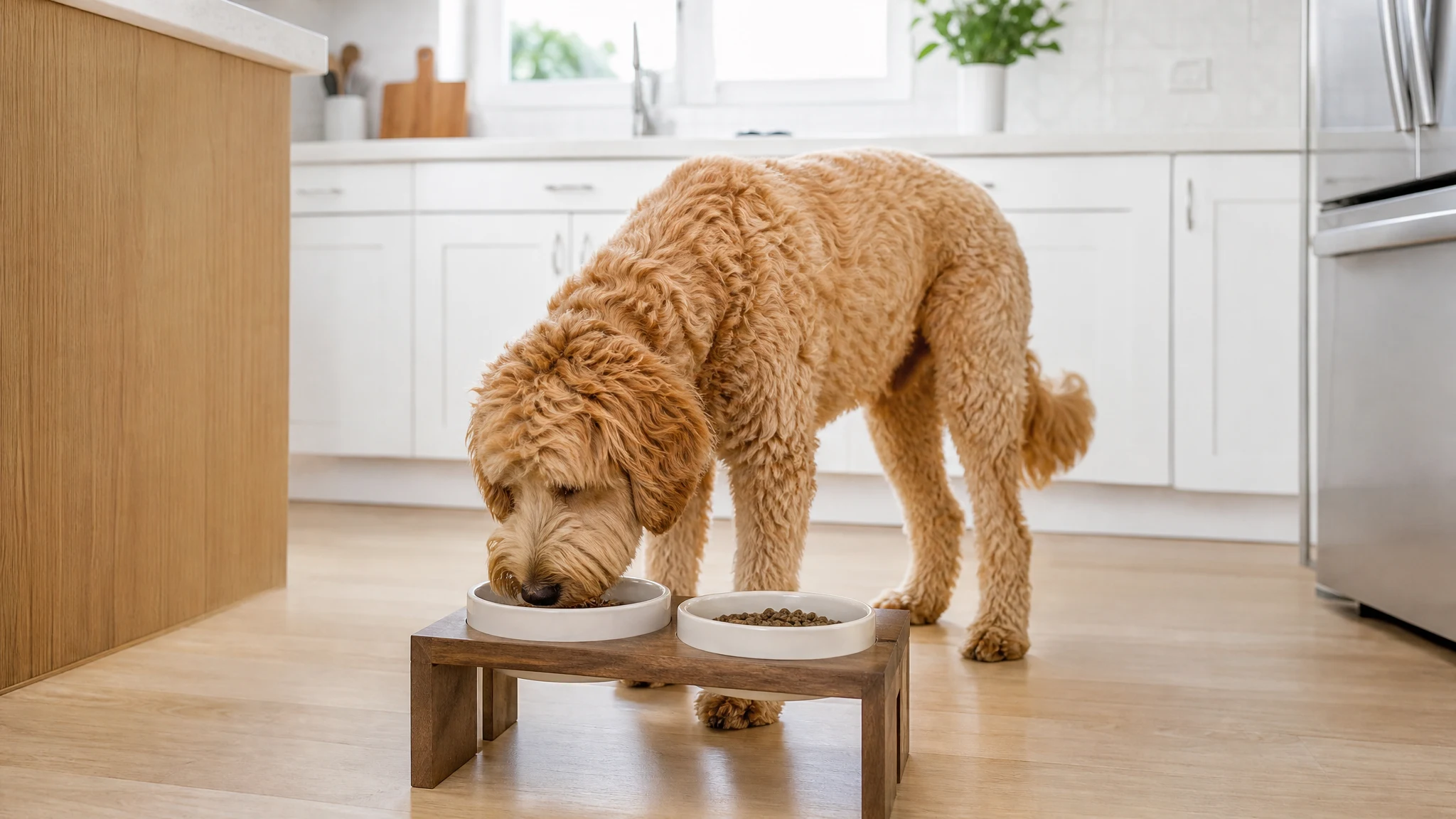
General nutrition information compiled from product labels and published sources, not veterinary advice. Your veterinarian is the right person to choose a diet for your dog, especially one with a health condition.
Most weeknights are crowded. Work runs late, the kids need a ride, and the dog is already waiting by the bowl. A simple dog feeding preparation routine takes the guesswork out of those moments.
This guide shows how to set up one weekly prep session for your Goldendoodle. It works for dry food, wet food, fresh food, or a mix. It does not require special skills, only a little planning.
Why Goldendoodle Size Changes Your Prep
A Goldendoodle is a Golden Retriever and Poodle cross. There is no kennel-club standard for the cross. The Goldendoodle Association of North America (GANA), a breeder association, describes four sizes based on height:
- Petite Mini: under 14 in, typically 25 lb or less
- Mini: 14 to 17 in, typically 26 to 35 lb
- Medium: 17 to 21 in, typically 36 to 50 lb
- Standard: over 21 in, typically 51 lb or more
Size depends on the Poodle parent and the generation, so these are ranges, not promises. Your dog's size decides how big each meal is and which type of food suits the dog. Your veterinarian can confirm your own dog's target weight.
Materials You Need
- A kitchen scale that reads in grams or ounces. Scoops vary a lot, and a scale is the most repeatable way to portion.
- A standard 8 oz measuring cup, if you prefer cups.
- Airtight containers for opened dry food, or a sealed bin with the original bag kept inside it so the lot number and best-by date stay visible.
- Small reusable containers or zip bags for daily portions.
- Masking tape and a marker for dates and names.
- Freezer and refrigerator space if you feed a fresh or frozen food.
- Your dog's current food bag or tin, so you can read the label.
- A notebook or phone note to record weight and body condition.
Step-by-Step: A Weekly Dog Feeding Preparation Routine
Step 1: Read the label on the food you already use
Start with the bag, not the marketing on the front. Find the nutritional adequacy statement. It tells you which life stage the food is made for, and the wording matters.
For a growing puppy, the Merck Veterinary Manual explains that foods labeled for growth or all life stages must say either "including growth of large-size dogs (70 lb or more as an adult)" or "except for growth of large-size dogs." The "including" wording means the food meets the AAFCO calcium level set for large-size growing dogs.
This matters most for a Standard Goldendoodle. The Merck Veterinary Manual notes that too much calcium is a bigger concern in growing large-breed dogs. Mini and petite Goldendoodles are small dogs, so check that the label matches the size your puppy is expected to reach.
Step 2: Decide the daily amount from the label, then adjust with your vet
Feeding guides on food packaging are starting points. They are not a prescription. Two foods can call for very different volumes for dogs of similar weight, because calories per cup differ.
Here are some label guides, as examples of that spread:
- Royal Canin Large Adult lists 2 cups plus 7/8 cup (274 g) per day for a 57 lb dog with low activity, at 360 kcal ME per cup.
- Hill's Science Diet Adult Large Breed lists 3 1/4 cups (320 g) per day for a 50 lb dog, at 365 kcal per cup.
- Hill's Science Diet Adult 6+ Large Breed lists 3 cups (295 g) per day for a 50 lb dog, at 352 kcal per cup.
- Royal Canin Medium Adult recommends 2 to 4 equal portions per day, at 340 kcal ME per cup.
These are different foods, different weights and different brand tables, so do not compare them cup for cup. The point is to use the guide on your own bag, for your dog's current weight, and then watch the dog's body condition.
For age-based amounts and meal counts, see our Goldendoodle feeding chart by age. Use it alongside the label, not instead of it.
If your dog has a health condition, is underweight or overweight, or is on any special diet, confirm amounts with your veterinarian before you prep anything. The American Kennel Club notes that some Golden Retrievers can become overweight, and a Goldendoodle can inherit that tendency. Activity level matters too, so a dog that hikes every weekend may need a different amount than a mostly indoor dog.
Step 3: Set a fixed schedule you can actually keep
Pick meal times that fit your real day, then write them down. Many owners feed twice a day. Royal Canin's Medium Adult page suggests splitting the daily amount into 2 to 4 equal portions. Puppies often eat more meals per day than adults, so ask your vet about the right number for your puppy.
Standard Poodles are listed by the American Kennel Club as more at risk for gastric dilatation with volvulus (bloat), and a Standard Goldendoodle can inherit that risk. Ask your veterinarian whether your dog should have smaller meals and a calm period around mealtimes. Do not rely on a food choice alone to manage this.
Step 4: Portion a week of meals in one sitting
Pick one low-pressure time, such as Sunday afternoon. Set the scale to zero with an empty container on it, then weigh each meal.
- Line up seven days of containers, or fourteen if you feed twice a day.
- Weigh each portion and seal it.
- Label each with the day and meal.
- Stack them where you will see them at feeding time.
Weighing beats scooping. A heaped scoop can hold noticeably more kibble than a level one, and over weeks that adds up to extra calories.
Step 5: Handle fresh, frozen or wet food with care
Fresh food needs more planning, but it can still fit a busy week. The brand pages give these handling notes:
- JustFoodForDogs says to store its fresh recipes in the freezer, thaw them in the refrigerator, and use them within 5 days once opened.
- Nom Nom says its meals ship frozen or cold, should be stored in the freezer and thawed in the fridge overnight, and keep in the fridge up to 5 days once defrosted. Nom Nom calculates portions for each dog from the details the owner provides.
Move the next two or three days of meals to the fridge the evening before. Do not thaw on the counter. If you use canned food, such as Hill's Science Diet Adult Chicken & Barley Entrée in a 13 oz can, check the brand's own storage directions for opened cans.
Fresh and canned foods are far lower in calories per ounce than kibble, so the volume looks much bigger. The JustFoodForDogs Chicken & Rice Recipe is listed at 43 kcal ME per ounce. The Nom Nom Turkey Fare is listed at 244 kcal per cup. Follow the brand's portion guidance and keep your vet in the loop.
Step 6: Store opened dry food properly
Keep dry food in a cool, dry spot with the lid closed. Keep the original bag, or at least a photo of the label, so you have the best-by date and lot number. If you ever need to check a recall, that information is what you need.
Buy sizes you will finish in a reasonable time. A large bag is not a bargain if it sits open for months.
Step 7: Weigh the dog and review the plan every few weeks
A prep routine only works if the amounts still fit the dog. Weigh your Goldendoodle on a schedule, and note body condition in your log. If weight is climbing or dropping, tell your vet before changing the portions on your own.
Growing puppies change fast. Brands also set different end points for puppy foods. Royal Canin labels its Large Puppy food for large-breed puppies up to 15 months old, while Hill's labels its Large Breed puppy food for up to 18 months. Ask your vet when to move your own dog to an adult food.
Choosing Which Food to Prep
No Goldendoodle-specific commercial formula turned up in the sources we checked. The products below are size-based, so they depend on how big your dog is expected to be. We compared label data from the brands' own pages. We did not run feeding trials or taste tests, and this is not a ranking.
| Food | Stage and size | Label statement type | Calories |
|---|---|---|---|
| Royal Canin Large Puppy | Large-breed puppy, adult weight 56 to 100 lb, up to 15 months | Formulated to meet AAFCO levels for growth, including large-size dogs | 349 kcal ME per cup |
| Hill's Science Diet Puppy Large Breed | Large-breed puppy, over 55 lb as an adult, up to 18 months | AAFCO feeding-test claim for growing puppies, without the large-size phrase | 391 kcal per cup |
| Hill's Science Diet Puppy Small & Mini | Small and mini puppies up to 1 year | AAFCO feeding-test claim for growth | 418 kcal per cup |
| Royal Canin Medium Adult | Adult, 23 to 55 lb, over 12 months | Formulated for maintenance | 340 kcal ME per cup |
| Royal Canin Large Adult | Adult, 56 to 100 lb, over 15 months | Formulated for maintenance | 360 kcal ME per cup |
| JustFoodForDogs Chicken & Rice | Fresh, all life stages | Formulated for all life stages, including large-size growth | 43 kcal ME per oz |
| Nom Nom Turkey Fare | Fresh, all life stages | Formulated for all life stages, including large-size growth | 244 kcal per cup |
Notice the two different kinds of AAFCO claim. "Formulated to meet" means the recipe was built to the AAFCO nutrient levels. A feeding-test claim means animal feeding tests using AAFCO procedures were done. Both are valid claims, and neither tells you how your individual dog will do. Report only what the label says, and ask your vet which fits your dog.
Protein, fat and fiber figures are not given the same way across brands. Hill's pages show dry-matter averages rather than the minimums and maximums on a guaranteed analysis, so those numbers do not line up directly with a Royal Canin label. Check the brand page for the full panel before you decide.
A note on grain-free and heart health
Many owners ask about grain-free food. The FDA began investigating reports of dilated cardiomyopathy (DCM) in dogs eating certain foods in July 2018. Many of these foods were labeled grain-free, with peas, lentils, other pulses or potatoes among the first 10 ingredients. The FDA's latest public update is dated December 23, 2022, and the agency said it would not release more until there is meaningful new science.
A UC Davis news release from January 2019 described taurine-deficient DCM in golden retrievers, 23 of 24 of which had been fed grain-free, legume-rich or combination diets. Because a Goldendoodle has a Golden Retriever parent, this is worth a conversation with your vet. Nothing here shows that grain-free food causes DCM, and none of the foods listed above are grain-free.
Tips for Staying on Track
- Prep right after you shop, while the food and containers are out.
- Keep a spare day of portions in the freezer or pantry for chaotic weeks.
- Write feeding times and amounts on a card near the bowl, so anyone in the house can feed correctly.
- If a sitter feeds your dog, hand over pre-portioned, labeled meals. It prevents accidental double feeding.
- Count treats and chews in the day's calories, and ask your vet how much room to leave for them.
- Switch foods gradually over several days, and ask your vet for the schedule that suits your dog.
Common Mistakes to Avoid
- Scooping by eye. Scoops drift. Weigh the portions.
- Following the puppy table for too long. Puppy foods end at different ages by brand, and your vet decides when to move on.
- Treating label amounts as fixed. They are starting points. Body condition and your vet's advice come first.
- Thawing fresh food on the counter. Use the fridge, and follow the brand's use-within window.
- Adding supplements on your own. Check with your vet before adding any, and do not guess at amounts.
- Making a homemade diet from internet recipes. A complete and balanced diet is hard to build. If you want one, ask your vet for guidance.
- Using a prescription diet without a prescription. Those are only for dogs a veterinarian has put on them.
- Using a food to try to prevent or manage a condition. A food does not treat hip dysplasia, allergies or bloat. Your vet decides what is right for an individual dog.
What Results to Expect
A steady routine can make feeding calmer and more consistent. You may find mealtimes take less time, there are fewer skipped or doubled meals, and the dog's weight is easier to track.
It may also make it easier to notice changes early, such as a dog leaving food or gaining weight. Results vary by dog, and a routine does not replace veterinary care. If appetite, stools or weight change, call your vet.
Quick Checklist
- Read the label and its adequacy statement.
- Find the daily amount for your dog's weight and confirm it with your vet.
- Set meal times.
- Portion by weight once a week.
- Store dry food sealed and fresh food cold, per the brand's directions.
- Weigh your dog and adjust with your vet.
Sources
- Goldendoodle Association of North America, Goldendoodle Breed Standard
- American Kennel Club, Golden Retriever breed page
- American Kennel Club, Poodle (Standard) breed page
- Merck Veterinary Manual, Dog and Cat Foods
- Merck Veterinary Manual, Nutritional Requirements of Small Animals
- U.S. FDA, Investigation into Potential Link between Certain Diets and Canine Dilated Cardiomyopathy
- UC Davis, Dogs Fed Some Popular Diets Could Be at Risk of Heart Disease
- Royal Canin US, Large Puppy Dry Dog Food
- Royal Canin US, Medium Adult Dry Dog Food
- Royal Canin US, Large Adult Dry Dog Food
- Hill's Pet Nutrition, Science Diet Puppy Large Breed
- Hill's Pet Nutrition, Science Diet Puppy Small & Mini
- Hill's Pet Nutrition, Science Diet Adult Large Breed
- Hill's Pet Nutrition, Science Diet Adult 6+ Large Breed
- Hill's Pet Nutrition, Science Diet Adult Chicken & Barley Entrée
- JustFoodForDogs, Chicken & Rice Recipe
- Nom Nom, Turkey Fare