Goldendoodle Feeding Chart: Cups Per Day by Activity Level
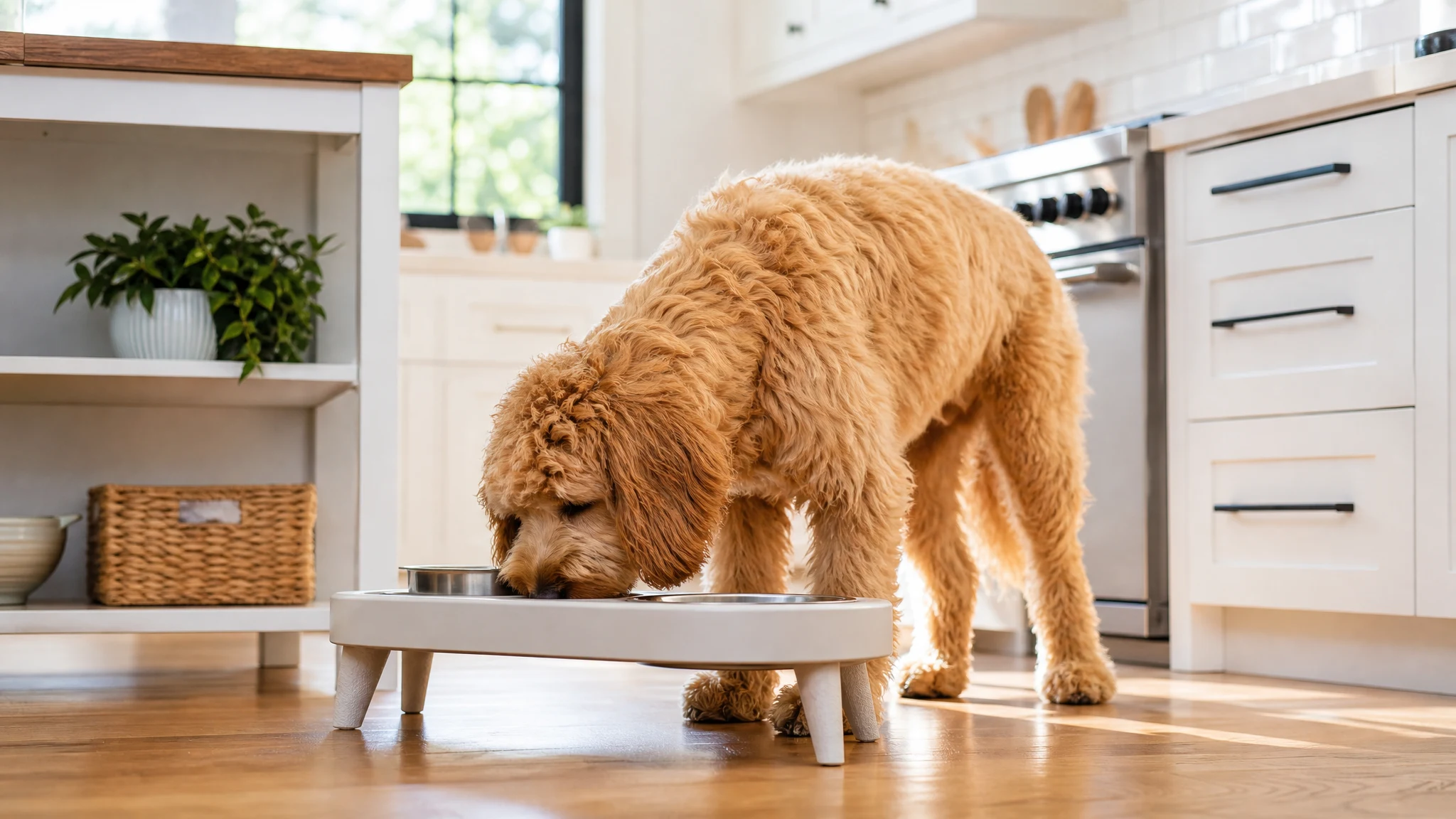
General nutrition information compiled from product labels and published sources, not veterinary advice. Your veterinarian is the right person to choose a diet for your dog, especially one with a health condition.
Most owners want one simple dog feeding chart that says how many cups a Goldendoodle needs each day. The honest answer is that no single chart fits every Goldendoodle. The breed ranges from petite minis to standards, and food brands differ a lot in calories per cup.
This guide shows you how to build a chart for your own dog. You start with the feeding guide printed by the food's maker, then adjust for activity level. Then you check your dog's body shape every couple of weeks and fine-tune.
Why a single Goldendoodle chart does not exist
The Goldendoodle Association of North America (GANA) describes sizes by height, with typical weights attached. Its breed standard lists these ranges:
- Petite Mini: under 14 inches, typically 25 lb or less
- Mini: 14 to 17 inches, typically 26 to 35 lb
- Medium: 17 to 21 inches, typically 36 to 50 lb
- Standard: over 21 inches, typically 51 lb or more
GANA is a breeder association, not a kennel club, and its standard is self-published. Your dog's size also depends on the Poodle parent and the generation. A standard Goldendoodle can weigh several times what a petite mini does, so the cups per day can differ just as much.
That is why this page teaches a method instead of handing you one set of numbers. If the numbers on a chart are not tied to a specific food, they are a guess.
Materials you need
- The food's bag, can or package, with the full feeding guide and the calorie statement (kcal per cup)
- A standard dry measuring cup, or a kitchen scale that reads in grams
- A notebook or phone note to track amounts, treats and weight
- A bathroom scale, or your vet's scale, for a current weight
- Your dog's age and best estimate of adult size
- Your veterinarian's contact details, for any health question
Step 1: Pick a food made for your dog's life stage and size
The feeding guide only means something if the food suits your dog. Look for the AAFCO statement on the label. It says whether the food is complete and balanced for growth, maintenance or all life stages.
The Merck Veterinary Manual explains one detail that matters for larger doodles. A food labeled for growth or all life stages must say either "including growth of large-size dogs (70 lb or more as an adult)" or "except for growth of large-size dogs." The "including" wording means the food meets the calcium levels AAFCO sets for large-size growing dogs. The Merck Veterinary Manual also notes that excess calcium matters most for growing large- and giant-breed dogs. Standard Goldendoodle puppies fall in that group, while mini and petite sizes are small dogs.
Here is how a few labels read. We compared label data only. We did not run feeding trials or taste tests.
- Royal Canin Large Puppy states it meets AAFCO nutritional levels for growth "including growth of large size dogs (70 lb. or more as an adult)." The brand labels it for large-breed puppies up to 15 months old.
- Hill's Science Diet Puppy Large Breed carries an AAFCO feeding-test statement for growing puppies. The page's statement does not include the "including growth of large-size dogs" phrase. The brand labels it for large-breed puppies up to 18 months old.
- Royal Canin Medium Adult states it meets AAFCO levels for maintenance and is labeled for medium-breed dogs over 12 months old.
For a deeper look at puppies and growth stages, see our guide to the Goldendoodle feeding chart by age.
Step 2: Find the calories per cup
Two foods can both say "one cup" and deliver very different calories. Before comparing cups, compare kcal per cup. These figures come from each brand's own product page:
| Food | Label calories |
|---|---|
| Royal Canin Medium Adult (dry) | 340 kcal ME per cup |
| Royal Canin Large Adult (dry) | 360 kcal ME per cup |
| Royal Canin Large Puppy (dry) | 349 kcal ME per cup |
| Hill's Science Diet Adult Large Breed (dry) | 365 kcal per cup |
| Hill's Science Diet Adult 6+ Large Breed (dry) | 352 kcal per cup |
| Hill's Science Diet Puppy Large Breed (dry) | 391 kcal per cup |
| Hill's Science Diet Puppy Small & Mini (dry) | 418 kcal per cup |
| Nom Nom Turkey Fare (fresh) | 244 kcal per cup (8 oz measuring cup) |
Notice the spread. A cup of Hill's Puppy Small & Mini is listed at 418 kcal, while a cup of Nom Nom Turkey Fare is listed at 244 kcal. Swapping foods without changing the measured amount can quietly change how much your dog eats. JustFoodForDogs does not state calories per cup on its Chicken & Rice page. It lists 43 kcal ME per ounce, so check the brand for portion guidance.
Step 3: Read the brand's own feeding guide
Every complete food prints a feeding table by body weight. Treat it as a starting point, not a prescription. A few real examples from the brands show how different the tables can look:
- Royal Canin Large Adult lists 2 7/8 cups (274 g) per day for a dog with a 57 lb target adult weight and low activity.
- Hill's Science Diet Adult Large Breed lists 3 1/4 cups (320 g) per day for a 50 lb dog.
- Hill's Science Diet Adult 6+ Large Breed lists 3 cups (295 g) per day for a 50 lb dog.
- Hill's Science Diet Puppy Small & Mini lists 1/2 cup (55 g) per day for a 2 lb puppy under 4 months old.
- Royal Canin Medium Adult recommends feeding 2 to 4 equal portions per day.
These amounts apply only to those exact foods. Do not carry a cup figure from one brand to another. Look up your own food's table, find your dog's current weight (or target adult weight, for puppies), and write down the number.
Step 4: Adjust for activity level
Feeding guides assume an average dog. Your Goldendoodle may be more or less active than that. Brands do not publish a Goldendoodle-specific activity multiplier, so we will not invent one. Here is a practical way to think about it:
- Low activity (short walks, mostly indoors, older dogs): start at the low end of the label's range for your dog's weight. The Royal Canin Large Adult table, for example, ties its example amount to low activity.
- Moderate activity (daily walks, some play): start at the middle of the label's range.
- High activity (running, hiking, sport training): start at the higher end of the range, then watch body condition closely.
Make changes in small steps. Hill's guidance on its feeding tables is to adjust amounts as needed to maintain optimal weight, and to ask your veterinarian if you are unsure. Many owners move by a small scoop at a time and wait a couple of weeks before judging the result.
Step 5: Split the day into meals
Royal Canin suggests 2 to 4 equal portions of its adult diet per day. Most adult doodles do well with two meals. Puppies often eat three or four smaller meals, and our age-based guide covers that.
The American Kennel Club notes that Standard Poodles are more at risk for gastric dilatation with volvulus, known as bloat. Goldendoodles can inherit this risk from a Standard Poodle parent. Smaller, spread-out meals are a common conversation to have with your vet. Ask your veterinarian what meal pattern suits your dog, since there is no label rule for it.
Step 6: Count treats and extras
Treats, chews, training rewards and table scraps all add calories. Count them in the daily total and trim the meal slightly on heavy training days. Keep treats small and write them in your notebook. Avoid adding supplements without asking your vet first, and never guess at amounts.
Step 7: Check body condition every two weeks
The scale and the cup are only tools. Your dog's body is the real measure. Every couple of weeks, check these things:
- Run your hands along the ribs. You should feel them under a thin layer of padding without pressing hard.
- Look from above. A healthy waist should be visible behind the ribs.
- Look from the side. The belly should tuck up a little behind the ribs.
- Weigh your dog on the same scale and write it down.
A thick coat can hide weight gain, so rely on touch more than sight. The AKC notes that some Golden Retrievers can become overweight, and Goldendoodles can inherit that tendency. If the ribs are hard to feel, reduce the daily amount slightly. If the ribs are very easy to see, increase it slightly. Ask your veterinarian to confirm what a healthy weight is for your dog.
Step 8: Change foods slowly
If you switch foods or move from a puppy food to an adult food, do it gradually over about a week or more, mixing the new food into the old. Remember to recheck the cups per day, since calories per cup will likely differ. Brands label the move to adult food at different ages (for example, Royal Canin's Large Puppy is for up to 15 months and Hill's Puppy Large Breed is for up to 18 months), and a doodle's adult size varies. Ask your vet when your dog is ready.
Sample worksheet
Fill this in for your own dog and food. It is your personal dog feeding chart.
| Item | Where to find it |
|---|---|
| Current weight and target adult weight | Your scale or vet's scale |
| Food and AAFCO statement | Bag or brand product page |
| kcal per cup | Bag or brand product page |
| Label cups per day for your dog's weight | Brand feeding table |
| Activity adjustment (low, moderate, high) | Your own daily routine |
| Meals per day | Label guide and your vet |
| Treat allowance | Your notebook |
Common mistakes to avoid
- Copying a chart from a different food. Cup sizes mean different calories in different foods.
- Guessing the size of the cup. A coffee mug or a scoop that came with another product is not a standard measuring cup. Fresh food brands may use their own cup size, such as Nom Nom's 8 oz cup.
- Ignoring treats. They add up fast.
- Feeding by age alone. A 7-month-old mini and a 7-month-old standard need very different amounts.
- Assuming grain-free is better. The U.S. FDA began investigating reports of dilated cardiomyopathy (DCM) in dogs eating certain foods in July 2018. Many of them were labeled grain-free and had peas, lentils, other pulses or potatoes among the first 10 ingredients. FDA's last public update is dated December 23, 2022, and it said it does not plan more updates until there is meaningful new science. A UC Davis study also found taurine-deficient DCM in golden retrievers, most of whom had eaten grain-free, legume-rich or combination diets. None of this proves a cause, and it does not mean other diets are risk-free. Talk with your vet about the right food for your dog.
- Treating label amounts as fixed. They are starting points.
Tips that help
- Weigh the food in grams if you can. Brands such as Royal Canin and Hill's list gram amounts next to cups, and a scale is more consistent than a cup.
- Write down a change and the date, so you can tell what worked.
- Keep the same food while you adjust amounts, so you change only one thing at a time.
- For fresh and frozen foods, follow the brand's storage rules. JustFoodForDogs and Nom Nom both say to keep the food frozen, thaw it in the refrigerator and use it within 5 days once opened or defrosted.
What to expect
If you follow these steps, you may find your dog holds a steady weight and keeps a visible waist. Results vary with age, genetics, health and routine. It can take a few weeks of small adjustments to settle on an amount. A well-chosen portion may also make mealtimes simpler, but no feeding plan can promise a particular outcome.
When to ask your veterinarian
A food does not prevent, treat or cure any disease, and only your veterinarian can decide what is right for an individual dog. Check with your vet before setting amounts if your dog:
- Has a health condition, such as pancreatitis, a liver condition or a heart condition. The Merck Veterinary Manual notes that Poodles are among the breeds with reported increased pancreatitis prevalence, and that liver shunts are more common in large breeds including Golden Retrievers. Goldendoodles can inherit such risks from their parent breeds.
- Is pregnant, nursing, a fast-growing large puppy, or a senior.
- Is losing or gaining weight without a clear reason.
- Needs a prescription diet. Only a veterinarian can prescribe one.
If your dog has any health condition, confirm the daily amount with your vet before you rely on a label guide. For exact feeding guidance on any product, check with the brand directly.
Sources
- Goldendoodle Association of North America, Goldendoodle Breed Standard
- Merck Veterinary Manual, Dog and Cat Foods
- Merck Veterinary Manual, Nutritional Requirements of Small Animals
- Merck Veterinary Manual, Pancreatitis in Dogs and Cats
- Merck Veterinary Manual, Congenital and Inherited Anomalies of the Liver in Animals
- American Kennel Club, Golden Retriever
- American Kennel Club, Poodle (Standard)
- U.S. FDA, Investigation into Potential Link between Certain Diets and Canine Dilated Cardiomyopathy
- UC Davis, Dogs Fed Some Popular Diets Could Be at Risk of Heart Disease
- Royal Canin US, Large Puppy Dry Dog Food
- Royal Canin US, Medium Adult Dry Dog Food
- Royal Canin US, Large Adult Dry Dog Food
- Hill's Pet Nutrition, Science Diet Puppy Large Breed
- Hill's Pet Nutrition, Science Diet Puppy Small & Mini
- Hill's Pet Nutrition, Science Diet Adult Large Breed
- Hill's Pet Nutrition, Science Diet Adult 6+ Large Breed
- JustFoodForDogs, Chicken & Rice Recipe
- Nom Nom, Turkey Fare