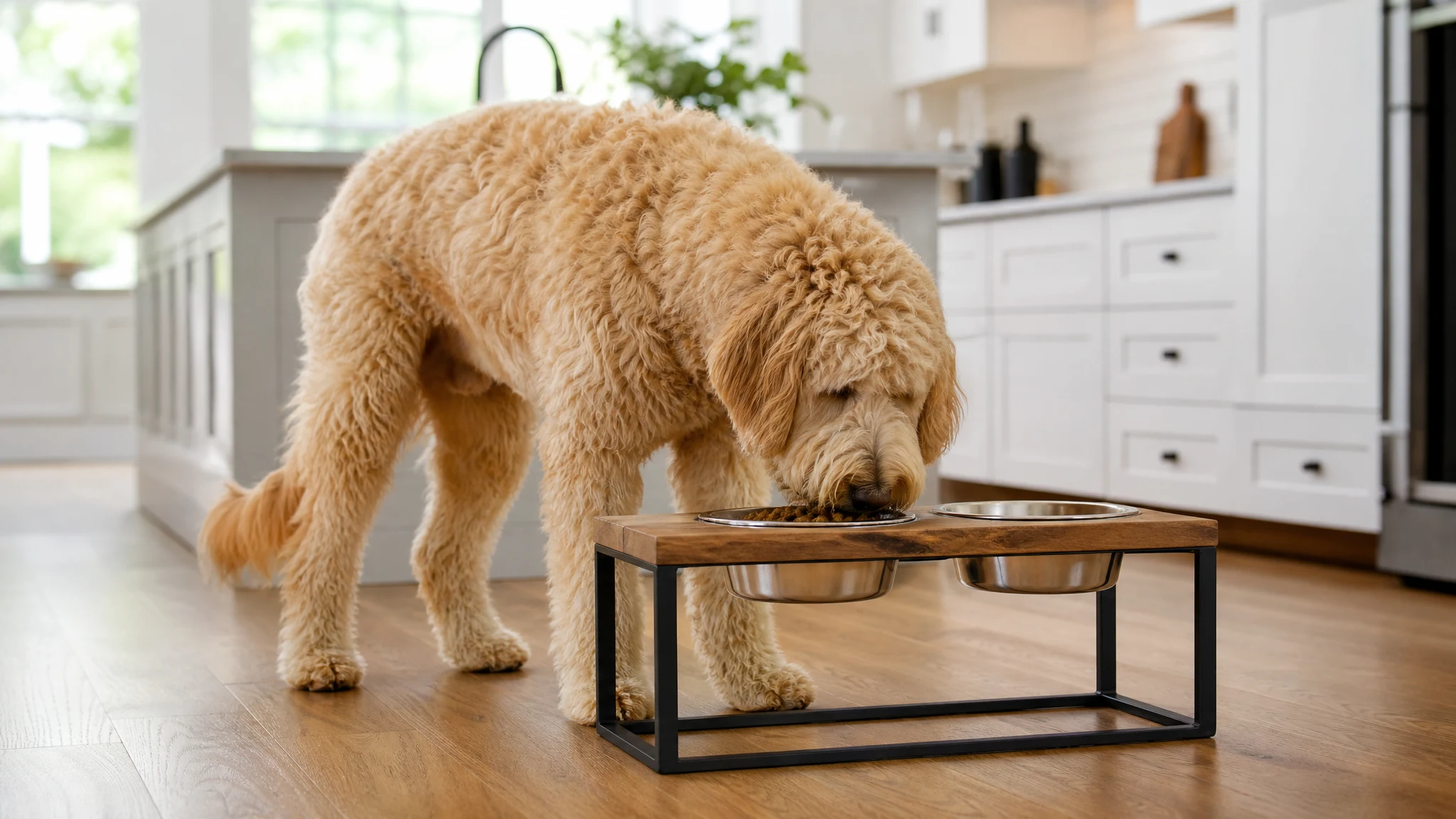
Feeding Stations for Goldendoodles: What to Look for in a Bowl Setup
General nutrition information compiled from product labels and published sources, not veterinary advice. Your veterinarian is the right person to choose a diet for your dog, especially one with a health condition.
A good dog feeding station is more than a bowl on the floor. It is a spot, a routine and a few tools that make meals calm, clean and easy to measure. For a Goldendoodle, size and coat shape the choices more than most owners expect.
This guide walks through building a simple setup, step by step. It covers what to buy, where to put it, how to measure meals, and which mistakes to skip. It does not review bowl brands, and it does not name any bowl product.
Why a Goldendoodle needs a thoughtful setup
Goldendoodles come in very different sizes. The Goldendoodle Association of North America (GANA), a breeder association rather than a kennel club, groups them by height. Its breed standard lists these typical weights:
- Petite Mini: under 14 inches, typically 25 lb or less
- Mini: 14 to 17 inches, typically 26 to 35 lb
- Medium: 17 to 21 inches, typically 36 to 50 lb
- Standard: over 21 inches, typically 51 lb or more
These are ranges, not promises. Your dog's adult size depends on the Poodle parent and on generation. A bowl that suits a petite mini will be too small for a standard, and the reverse is also true.
The setup also needs to suit the parent breeds. The American Kennel Club (AKC) notes that Standard Poodles are more at risk for gastric dilatation with volvulus, often called bloat. A Goldendoodle can inherit tendencies from either parent, but no source we found documents this for the cross itself. So treat it as a reason to talk with your veterinarian about mealtime habits, not as a diagnosis.
Materials you need
- Two bowls: one for food, one for water. Stainless steel or ceramic are easy to wash. Heavy bases resist sliding.
- A non-slip mat: a washable, lipped mat catches spilled kibble and splashed water.
- A measuring cup or a kitchen scale: a scale is more exact than a scoop.
- A lidded container: for dry food, so it stays in its original bag inside the container, away from heat and damp.
- A towel or washcloth: for a quick wipe of the beard after meals.
- Optional: a stand, slow feeder or snuffle mat: only if it fits your dog, as covered below.
Step 1: Choose a bowl that fits your dog's size
Start with the dog in front of you. Judge the bowl by how your Goldendoodle eats from it, not by the packaging.
Look at three things:
- Capacity: the bowl should hold a full meal with room to spare. If kibble piles over the rim, size up.
- Width: a small dog needs a bowl that is not too deep to reach the bottom. A standard needs one wide enough for its muzzle.
- Weight and base: a bowl that skids across the floor makes mealtimes messy and can startle a nervous eater.
Check the material too. Stainless steel and glazed ceramic have smooth surfaces that are easier to clean than scratched plastic. Replace any bowl that is chipped or deeply scratched, because food residue can collect in damage.
Step 2: Think about ears and beard
Many Goldendoodles have long, soft ears and a beard that gets wet and messy. This is practical, not medical. A narrower, taller bowl can keep ears out of the food. A snood or a clip may help on messy days. Keep the face towel at the station so food does not dry in the beard.
If you notice ongoing ear or skin trouble, mention it to your veterinarian. Do not assume the bowl or the food is the cause.
Step 3: Decide on bowl height
Raised feeders are popular, but the evidence does not make them an automatic upgrade. We found no source in our research that says a raised bowl is right or wrong for a Goldendoodle. Because Standard Poodles have a higher bloat risk, according to the AKC, ask your veterinarian before buying a stand, especially for a standard-size dog.
If your vet is fine with it, use these basics:
- Pick a height your dog can eat from without stretching up or crouching down.
- Make sure the stand is stable and does not wobble.
- Re-check the height as a puppy grows.
A bowl on the floor is a perfectly reasonable choice for many dogs.
Step 4: Pick the right spot
Place the station somewhere quiet, on an easy-to-clean floor, away from the busiest doorway. Dogs eat more calmly when they are not stepped around.
- Choose a corner with a wipeable floor such as tile or vinyl.
- Put the mat down first, then the bowls on it.
- Keep the water bowl beside the food bowl, in the same place every day.
- Keep other pets' bowls apart, so no one guards or steals food.
- Keep young children from reaching into the bowl while the dog eats.
If your home has more than one dog, give each one its own space. Teach everyone to leave a dog alone while it eats. Use calm, reward-based habits here. Do not punish a dog for guarding. Instead, ask your veterinarian or a qualified, reward-based trainer for help. The American Veterinary Society of Animal Behavior (AVSAB) advises against punishment-based and dominance methods.
Step 5: Set up measuring and storage
A feeding station works best when measuring is built in. Keep the cup or scale next to the food container so you do not guess.
Food labels give starting points. A few examples from the brands' own pages show how different foods read:
- The Hill's Science Diet Adult Large Breed Chicken & Barley Recipe page lists 365 kcal per cup, with a feeding table showing 3 1/4 cups (320 g) per day for a 50 lb dog.
- The Royal Canin Large Adult page lists 360 kcal ME per cup. Its table shows 2 cups plus 7/8 cup (274 g) for a 57 lb dog with low activity.
- The Nom Nom Turkey Fare page lists 244 kcal per cup and says portions are calculated per dog from the details the owner provides.
Notice that a cup of one food is not a cup of another. The calories per cup differ, so switching foods means re-checking the amount. These are label guides only. They are starting points, and your dog's body condition and activity level should shape the final amount.
For a breakdown by age, see our Goldendoodle feeding chart by age.
Storing fresh and dry food
- Dry food: keep it in a closed container in a cool, dry place.
- Fresh food: JustFoodForDogs says to store it in the freezer, thaw it in the refrigerator, and use it within 5 days once opened. Nom Nom says defrosted food keeps in the fridge up to 5 days. Follow the brand's own instructions.
- Wet food: follow the can label once opened.
Step 6: Set a meal schedule
Pick regular times and keep them. Royal Canin's Medium Adult page, for example, suggests feeding 2 to 4 equal portions per day. Puppies usually eat more often than adults, and the right split depends on age, size and your veterinarian's advice.
Use these habits:
- Measure the meal before you call your dog.
- Put the bowl down calmly and let the dog eat without interruptions.
- Pick up leftovers after a set time, especially wet or fresh food.
- Refill the water bowl with fresh water at each meal.
The AKC notes that some Golden Retrievers can become overweight. A Goldendoodle can inherit that tendency, so measuring each meal is a simple habit that helps you notice changes in weight. If your dog has a health condition, confirm amounts with your veterinarian before you change anything.
Step 7: Match the food to the size and life stage
The bowl setup works best when the food suits the dog. Labels give clues, and a few are worth reading closely.
For puppies, look for the AAFCO statement. According to the Merck Veterinary Manual, a food labelled for growth must say either "including growth of large-size dogs (70 lb or more as an adult)" or "except for growth of large-size dogs." The "including" wording means the food meets the AAFCO calcium level set for large-size growing dogs.
Some examples, read exactly as the brands print them:
- The Royal Canin Large Puppy page states "including growth of large size dogs (70 lb. or more as an adult)," for large-breed puppies up to 15 months old.
- The Hill's Science Diet Puppy Large Breed page carries a feeding-test statement for growing puppies. It does not use the "including" large-size phrase.
- The Hill's Science Diet Puppy Small & Mini page is for puppies up to 1 year old, which may suit petite and mini sizes.
We compared label data only. We did not run feeding trials or taste tests, and these examples are not recommendations. The Merck Veterinary Manual also notes that excess calcium matters most for growing large and giant-breed dogs, which may be relevant to standard Goldendoodles. Ask your veterinarian which food fits your dog.
Be careful with claims about disease. No food can be said to prevent or treat hip dysplasia, bloat, allergies or heart disease. Only a veterinarian decides what is right for an individual dog, and prescription diets come only from a veterinarian.
Step 8: Clean the station on a schedule
- Wash food bowls after each meal with warm water and dish soap.
- Wash water bowls daily, because slimy film can build up.
- Wash and dry the mat at least weekly, or sooner if it gets messy.
- Wipe the floor under the mat to catch crumbs and splashes.
- Wash the food scoop and container before you refill it.
Wash your hands after handling pet food, especially fresh or raw-style products.
Tips for a smoother setup
- Keep the spot constant. Dogs like routine, and a fixed spot helps.
- Use a slow feeder only if needed. If your dog gulps, ask your veterinarian before choosing a slow bowl. Make sure the pattern is easy to clean.
- Offer enrichment separately. A snuffle mat can be fun, but count those calories in the day's total.
- Adjust as your dog grows. A puppy's bowl, schedule and amounts will change as the dog approaches adult size.
- Write down what works. Note the cup size, the food, and the times, so everyone in the home feeds the same way.
Common mistakes to avoid
- Buying one size for the whole life. A puppy bowl may be too small within months for a standard.
- Using a cup without checking it. Scoops vary. Weigh a scoop once on a scale to see what it holds.
- Ignoring calories per cup. Different foods have different numbers, as the label examples above show.
- Leaving fresh food out. Follow the brand's storage times.
- Skipping the water bowl. A clean, full bowl should always be available.
- Buying a raised stand without asking. Check with your veterinarian first, especially for larger dogs.
- Exercising right around meals. Because of the bloat risk in Standard Poodles, ask your vet how to time meals and activity.
- Switching foods suddenly. Ask your veterinarian how to change foods gradually.
What results to expect
A tidy station is unlikely to change your dog's health on its own. It may, however, make mealtimes calmer and easier to manage. With regular measuring, you may find it simpler to notice changes in appetite or weight, and to report them to your veterinarian.
You may also see less mess on the floor and a cleaner beard, though results vary by dog. If your Goldendoodle shows sudden changes in eating, vomiting, a swollen belly or restlessness, contact a veterinarian right away.
Quick checklist
- Choose bowls that suit your dog's size and are easy to clean.
- Think about ears and beard.
- Ask your veterinarian about bowl height.
- Pick a quiet, wipeable spot.
- Set up measuring and storage.
- Follow a steady meal schedule.
- Match the food to the dog's size and life stage.
- Clean on a regular schedule.
Sources
- Goldendoodle Association of North America, Goldendoodle Breed Standard
- American Kennel Club, Poodle (Standard) breed page
- American Kennel Club, Golden Retriever breed page
- Merck Veterinary Manual, Dog and Cat Foods
- Merck Veterinary Manual, Nutritional Requirements of Small Animals
- Royal Canin US, Large Puppy Dry Dog Food
- Royal Canin US, Medium Adult Dry Dog Food
- Royal Canin US, Large Adult Dry Dog Food
- Hill's Pet Nutrition, Science Diet Puppy Large Breed
- Hill's Pet Nutrition, Science Diet Puppy Small & Mini
- Hill's Pet Nutrition, Science Diet Adult Large Breed
- JustFoodForDogs, Chicken & Rice Recipe
- Nom Nom, Turkey Fare