Elevated vs Floor Feeding for Goldendoodles: Does It Matter?
General nutrition information compiled from product labels and published sources, not veterinary advice. Your veterinarian is the right person to choose a diet for your dog, especially one with a health condition.
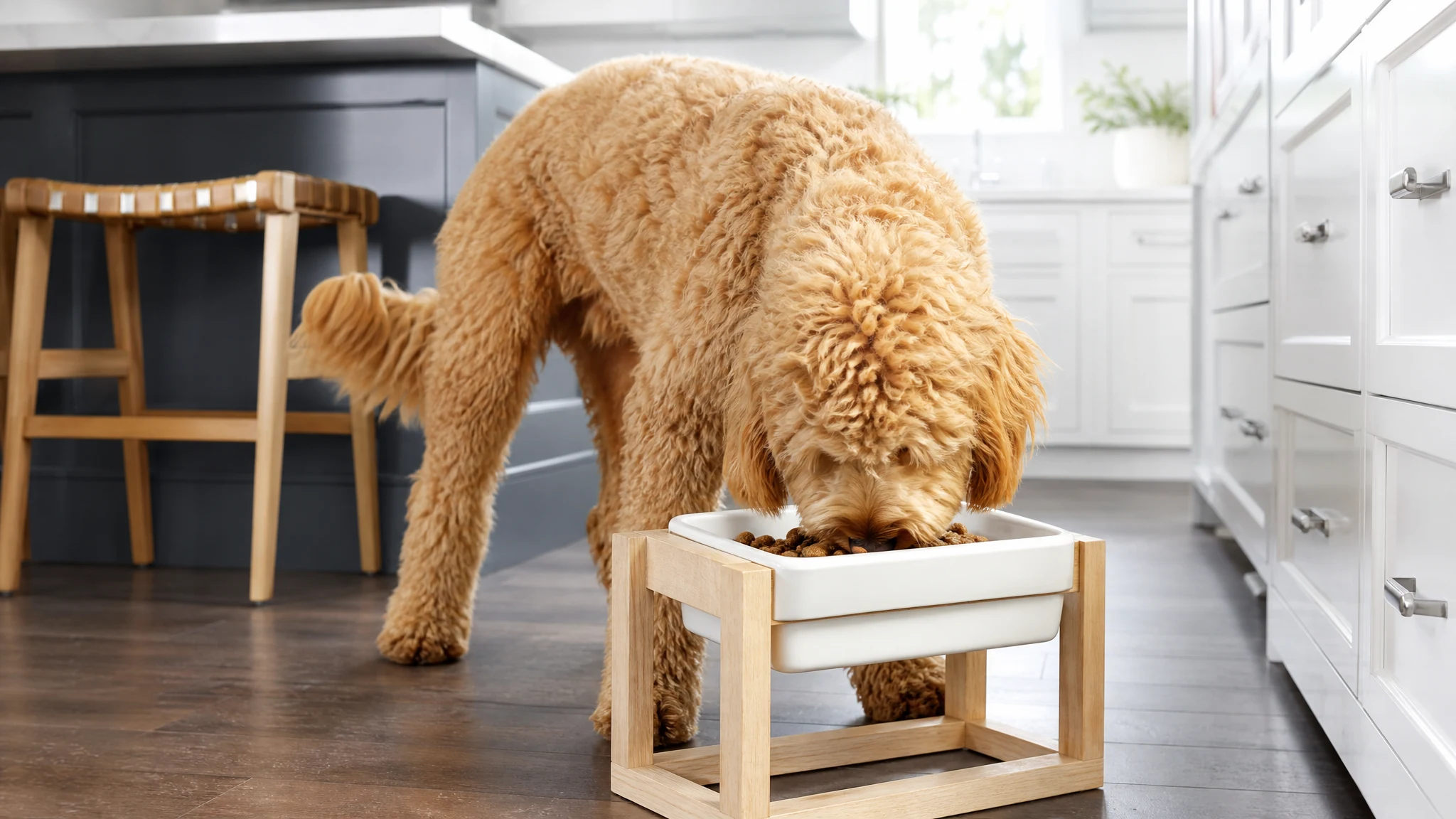
Raised bowls are sold with big promises. Better digestion, less bloat, less strain on joints. Floor bowls, on the other hand, are what most dogs have eaten from for a very long time.
So which is right for your Goldendoodle? The honest answer is that it depends on the dog, and a veterinarian is the right person to decide for an individual dog. This guide shows you how to set up a dog feeding station, how to test both heights, and how to read a food label so the bowl is not the only thing you think about.
We compared label data and published breed information for this page. We did not run feeding trials or taste tests, and we have not fed any of these foods ourselves.
Why this question comes up for Goldendoodles
Goldendoodles come in several sizes. The Goldendoodle Association of North America (GANA), a breeder association and not a kennel club, groups them by height. Its breed standard lists typical weights of 25 lb or less for Petite Minis, 26 to 35 lb for Minis, 36 to 50 lb for Mediums, and 51 lb or more for Standards.
That spread matters. A bowl height that suits a 30 lb Mini will be wrong for a 65 lb Standard.
The bloat worry is the main reason owners consider raised bowls. The American Kennel Club (AKC) breed page says the Standard Poodle is more at risk for gastric dilatation with volvulus, also called bloat or GDV. A Goldendoodle is a cross, and no source we relied on documents bloat risk for Goldendoodles as such. So the careful way to put it is that a Goldendoodle can inherit traits from a Standard Poodle parent.
Does a raised bowl change that risk? We did not find a source in our research that settles it, so we will not claim it does or does not. If bloat concerns you, ask your veterinarian before you buy or skip a raised feeder.
What you need
- Your dog's current food and its bag or can, so you can read the label.
- A measuring cup, or a kitchen scale if the label gives grams.
- A floor bowl that is stable and does not slide. Stainless steel or ceramic are common choices.
- A raised stand or feeder, only if you want to compare. A sturdy box or step stool can stand in for a short trial.
- A tape measure.
- A non-slip mat for under the dog feeding station.
- A notebook or phone note to record what you see.
You do not need to buy anything expensive to find out what suits your dog.
Step-by-step: set up and compare your dog feeding station
1. Measure your dog
Stand your Goldendoodle on a flat floor. Measure from the floor to the point of the shoulder (the top of the front leg where it meets the body). Write the number down.
Also weigh your dog, or use the last vet weight. GANA sizes by height, but food labels work by weight, so you need both.
2. Start with the floor
Place a bowl on a non-slip mat in a quiet spot, away from foot traffic and other pets. A calm place helps a dog eat at a steady pace.
Feed one or two ordinary meals here and watch. Does your dog gulp? Gag? Push the bowl around? Pick food out and drop it? Make notes. These notes tell you whether there is a problem to solve at all.
3. Decide whether you have a reason to change
Many dogs do fine on the floor. Reasons to talk to your vet about a change include:
- Your dog has neck, back or joint discomfort that makes bending hard.
- Your dog is older and stiff.
- Your dog has a condition where a vet has suggested a raised bowl.
If none of these apply, there is no label, source or study in our research that says a Goldendoodle must eat from a raised bowl.
4. If you test a raised bowl, set the height carefully
A common rule of thumb is to place the bowl rim near lower chest level, so your dog does not have to stretch up or crouch down. Use your measurement from step 1. Your dog should be able to eat with the neck fairly level.
A bowl set too high can make a dog reach up awkwardly. A bowl that is too low defeats the purpose. Adjust in small steps.
Because bloat is the concern with Standard Poodle parentage, ask your veterinarian about raised bowls first, especially for a Standard-sized Goldendoodle.
5. Measure the food, not the bowl
The bowl is only half of the setup. The amount matters just as much. Use the label's feeding guide as a starting point, then adjust with your vet if your dog gains or loses weight.
The label guides below show how widely amounts vary. These are examples from brand pages, not a recommendation for your dog:
| Food (brand page data) | Label guide example | Energy listed |
|---|---|---|
| Royal Canin Size Health Nutrition Large Adult | 57 lb target adult weight, low activity: 2 cups plus 7/8 cup (274 g) per day | 360 kcal ME per cup |
| Hill's Science Diet Adult Large Breed Chicken & Barley | 50 lb dog: 3 1/4 cups (320 g) per day | 365 kcal per cup |
| Royal Canin Size Health Nutrition Medium Adult | Feed in 2 to 4 equal portions per day | 340 kcal ME per cup |
| Hill's Science Diet Puppy Small & Mini | 2 lb puppy, under 4 months: 1/2 cup (55 g) per day | 418 kcal per cup |
Notice that the cup sizes and calories differ between brands. A cup of one food is not a cup of another. For a full breakdown by age, see our Goldendoodle feeding chart by age.
Weight, age and activity level all change the right amount. Hill's own guidance says to adjust feeding amounts to maintain optimal weight and to ask your veterinarian if you are unsure. If your dog has a health condition, confirm amounts with your vet.
6. Split meals and slow down the pace
Royal Canin's Medium Adult page suggests feeding the daily amount in 2 to 4 equal portions. Splitting the day's food into smaller meals is a simple way to avoid one large serving, whichever bowl height you use.
If your dog eats very fast, a slow-feeder bowl or a snuffle mat may help. Pick whichever is easy to clean.
Keep fresh water in a separate bowl at the same station. Wash both bowls daily.
7. Keep calm around mealtimes
Many owners ask whether exercise right before or after eating matters. We did not find a source in our research that gives a rule for Goldendoodles, so ask your vet. A quiet period around meals is a simple, low-cost habit that does no harm.
Teach a polite wait with reward-based training. Ask for a sit, put the bowl down, and release with a cheerful word. Never take the bowl away roughly or use force. Reward-based methods are the approach recommended by the American Veterinary Society of Animal Behavior (AVSAB).
8. Review after two weeks
Look back at your notes. Compare eating speed, mess, signs of discomfort and body condition. Check your dog's weight and waistline.
If you tested both heights, keep the one your dog handles most comfortably, unless your vet advises otherwise.
What the food label can tell you
A bowl is a small part of the picture. The label tells you far more about what your dog is eating.
Match the food to the size
Standard Goldendoodles can grow large. Merck Veterinary Manual explains that for a puppy expected to reach 70 lb or more, the label should say "including growth of large-size dogs (70 lb or more as an adult)." It also notes excess calcium is more of a problem for growing large- and giant-breed dogs. Mini and Petite doodles are small dogs, so this applies mainly to Standards.
Labels differ here. Royal Canin Large Puppy states the "including growth of large size dogs" wording. Hill's Science Diet Puppy Large Breed carries a feeding-test statement without that phrase. We are reporting each statement as printed, and we are not saying one is better. Ask your vet which suits your puppy.
Read the AAFCO statement
Look for words such as "complete and balanced" and a life stage: growth, maintenance or all life stages. If a food is for growth or all life stages, it should also say "including" or "except for" growth of large-size dogs.
Be careful with grain-free claims
The U.S. FDA began investigating reports of dilated cardiomyopathy (DCM) in dogs eating certain foods in July 2018. Many were labelled grain-free, with peas, lentils, other pulses or potatoes among the first 10 ingredients. FDA's latest public update is dated December 23, 2022, and it said it does not plan more public updates until there is meaningful new science.
A UC Davis release described taurine-deficient DCM in golden retrievers, 23 of 24 of which had eaten grain-free, legume-rich or combination diets. This is relevant because the Golden Retriever is a Goldendoodle parent. It does not prove that grain-free food causes DCM, and we are not claiming that. Talk to your vet before choosing a diet.
Fresh, dry or wet
The brands in our research include dry, wet and fresh foods. JustFoodForDogs Chicken & Rice and Nom Nom Turkey Fare both state they meet AAFCO profiles for all life stages including growth of large size dogs. Fresh foods are stored frozen and used within about 5 days of opening or defrosting, per those brand pages. Check each brand's own page for current labels.
Tips
- Choose a heavy, stable bowl or stand. A tipping stand can scare a dog.
- Keep the dog feeding station in the same place so meals feel predictable.
- Change one thing at a time: bowl height, then food, then schedule. Otherwise you will not know what helped.
- Weigh your dog regularly. The AKC notes some Golden Retrievers can become overweight, and a Goldendoodle can inherit that tendency.
- Count treats toward the daily amount.
- Switch foods gradually over several days and ask your vet about the pace.
Common mistakes to avoid
- Buying a raised feeder because of bloat fears. We found no source in our research showing that it prevents bloat. Ask your vet.
- Setting the stand too high. Match it to your measurement, not to a product photo.
- Guessing amounts. Use the label guide, a scale or measuring cup, and your vet's advice.
- Filling the bowl once and leaving it. Controlled portions make weight tracking easier.
- Using the wrong life-stage food. An adult food for a growing Standard puppy, or the reverse, can miss the label's intended use.
- Supplement guesswork. Do not add supplements on your own. Your vet decides, including any amount.
- Harsh mealtime discipline. Never use force, prong or choke collars, or dominance methods around food.
What to expect
Results vary by dog. Some owners find that a well-placed bowl may make mealtimes more comfortable, particularly for an older or stiff dog. Some find no difference at all.
A calm station, measured portions and a suitable food may help your dog eat at a steadier pace and keep a healthy weight. None of this is a guarantee, and no bowl or food prevents, treats or cures any disease, including bloat, hip dysplasia or heart disease.
GANA requires its breeders to submit hip, elbow, heart, patella and eye results to the Orthopedic Foundation for Animals (OFA). That screening is about breeding dogs, not about bowls. If you have joint or digestive concerns, your veterinarian is the one who can look at your dog.
When to call your vet
Call promptly if your dog has a swollen or tight belly, repeated unproductive retching, restlessness, or collapse. These can be signs of an emergency. Also ask your vet about frequent vomiting, coughing after meals, weight change or reluctance to eat.
Merck Veterinary Manual also notes that Poodles are among breeds with a reported increased prevalence of pancreatitis. Sudden appetite loss or belly pain deserves a veterinary visit, not a bowl experiment.
The short answer
For most healthy Goldendoodles, the available information does not show that elevated feeding is required. Floor feeding is a reasonable default, and a raised bowl is a choice to make with your vet, especially for a Standard-sized dog. Spend your effort on food choice, portions and a calm feeding routine.
Sources
- Goldendoodle Association of North America, Goldendoodle Breed Standard
- Goldendoodle Association of North America, Health Testing Standards
- American Kennel Club, Poodle (Standard)
- American Kennel Club, Golden Retriever
- Merck Veterinary Manual, Dog and Cat Foods
- Merck Veterinary Manual, Nutritional Requirements of Small Animals
- Merck Veterinary Manual, Pancreatitis in Dogs and Cats
- U.S. FDA, Investigation into Potential Link between Certain Diets and Canine Dilated Cardiomyopathy
- UC Davis, Dogs Fed Some Popular Diets Could Be at Risk of Heart Disease
- Royal Canin US, Large Adult Dry Dog Food
- Royal Canin US, Medium Adult Dry Dog Food
- Hill's Pet Nutrition, Science Diet Adult Large Breed
- Hill's Pet Nutrition, Science Diet Puppy Small & Mini